Craft village
Bao La
- Craft
- Bamboo weavingĐan tre
- Where
- Quảng Điền, Huế
- Practised since
- c. 600 yearsBaskets for the lagoon
- Material
- BambooSplit and woven by hand
- On LangSoul
- RecordedNot yet carried
01 — The story
Six hundred years of split bamboo
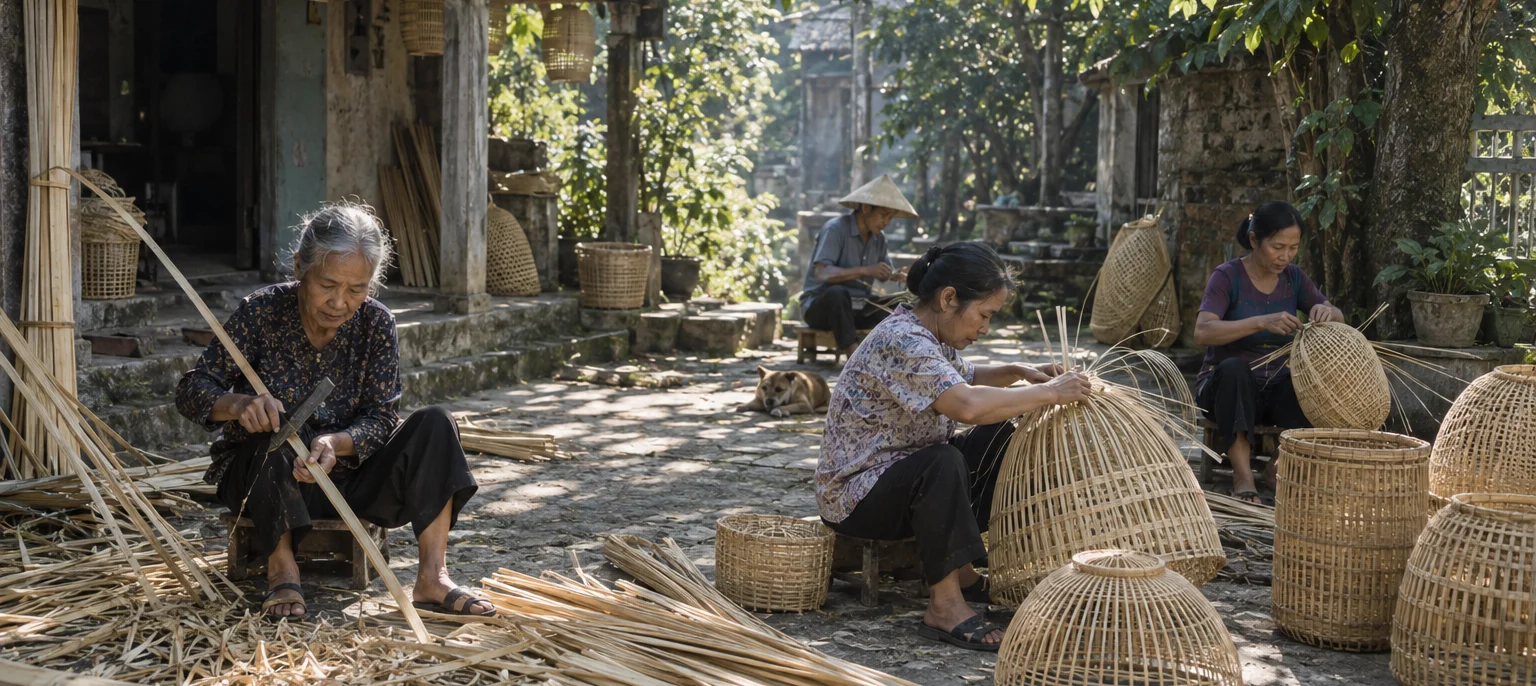
Bao La lies on the flat country between Huế and the Tam Giang lagoon, where bamboo grows in hedges around every house. The village has woven it for about six centuries, and for most of that time the work was entirely practical: winnowing trays, rice baskets, carrying baskets for the market, and the narrow fish traps set in the channels and paddies. Huế’s markets were supplied from here, and families tended to specialise in one or two shapes that their neighbours did not make.
The craft is still a household one. Men usually cut and split the bamboo; women and older people do much of the weaving, often in the shade of a porch between other work. Plastic has taken much of the market for everyday baskets, and some households now make lamps, boxes and trays for shops in Huế and Hội An. The traditional shapes have not disappeared, though, and you will see new fish traps stacked by the road in the right season.
In good Bao La work the strips are even in width and thickness, shaved smooth on the inner face so they do not splinter, and woven tight at the base where the load sits. The rim is the test: it should be bound firmly with split rattan or bamboo, without gaps or loose ends. Fresh pieces are pale green-gold and darken to honey with use. A well-made tray should sit flat on the floor and not rock.
02 — The technique
What makes Bao La bamboo weaving
A Bao La basket is built for weight and water, so the work begins with choosing the right culm.
I
Mature bamboo
Weavers cut culms of three years or more, which are stronger and less likely to be eaten by insects than young growth.
II
Strips split by knife
Each culm is split and shaved by hand into strips of the width the shape demands, fine for trays and broad for carrying baskets.
III
Smoked or soaked
Strips are soaked or dried over smoke to keep insects out, a quiet step that decides how long a piece will last.
IV
Bound rims
The rim is lashed over a bamboo hoop, which holds the shape and takes the wear of daily use.
Words you will meet
Tre
Bamboo.
Nan
A split strip of bamboo ready for weaving.
Nia
A wide, shallow round tray for winnowing and drying rice.
Lờ
A woven bamboo fish trap with a funnel mouth.
03 — Visiting
Visiting Bao La
Bao La is a working farming village rather than a showroom, so the best way to see the craft is to walk slowly along the lanes in the morning. Some households sell from the porch; elsewhere ask before photographing. LangSoul does not run trips here, but readers can write to us for an introduction.
- From Huế
- About 30 minutes by car or motorbike
- Best season
- February to August, when the lanes are dry
- Look for
- Even strips, a smooth inner face and a firmly bound rim
The other villages
The full atlas






