Craft village
Bàu Trúc
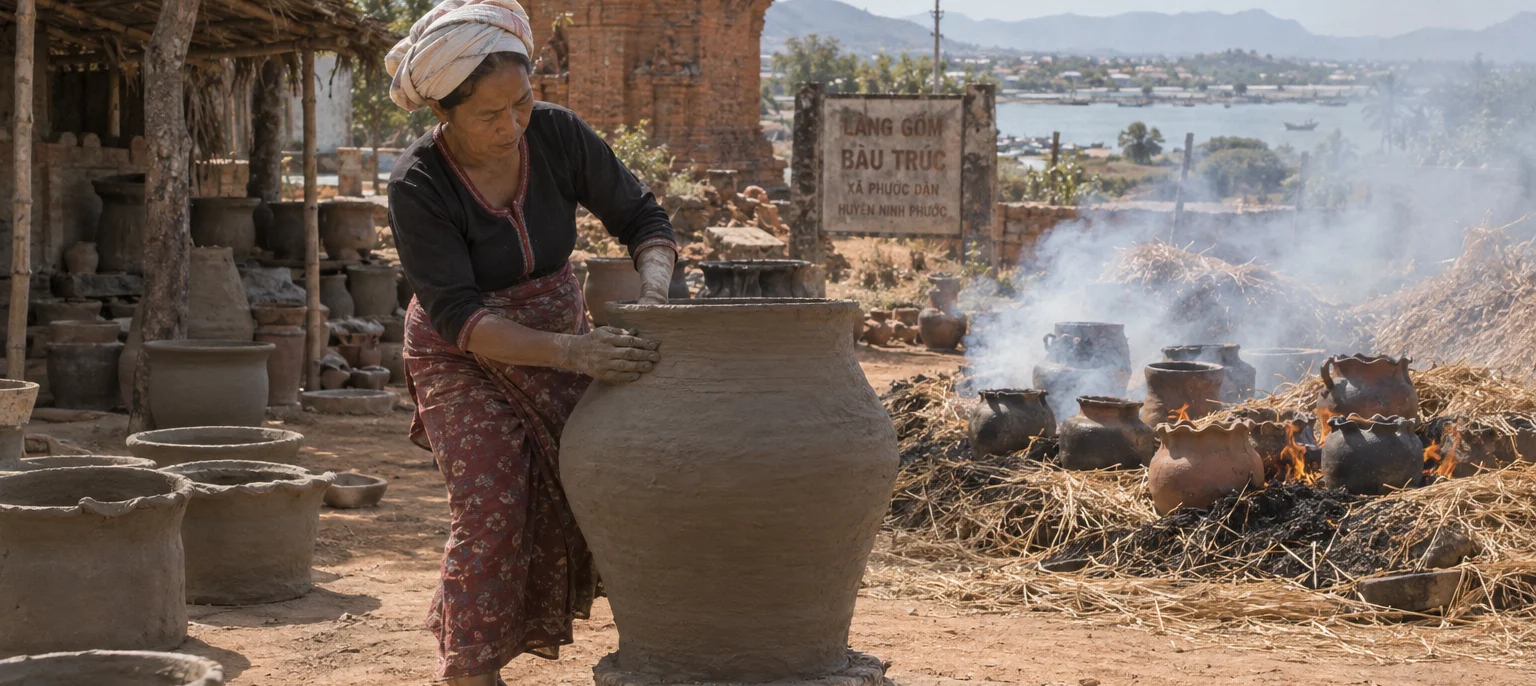
- Craft
- Cham hand-built potteryGốm Chăm
- Where
- Ninh Phước, Ninh Thuận
- Practised since
- Pre-15th centuryBuilt without a wheel
- Material
- Clay of the Quao riverOpen firing on straw
- On LangSoul
- RecordedNot yet carried
01 — The story
Pots built by walking backwards
Bàu Trúc is a Cham village near Phan Rang, in the dry country of Ninh Thuận where the Cham kingdom of Panduranga once lay. Its pottery is among the oldest continuous traditions in South-East Asia, and the Cham credit its teaching to an ancestral figure honoured in the village. The work belongs to women. They dig the clay from the Quao river, shape it by hand, and pass the craft from mother to daughter; men traditionally help with clay and fuel.
Bàu Trúc pottery is now well known, and in 2022 the art of Cham pottery-making was inscribed by UNESCO as heritage in need of urgent safeguarding. That recognition reflects a real worry: fewer young women are learning, and much of what is sold today are decorative pieces for visitors rather than the water jars and cooking pots the village once made. Many households still build and fire in the old way, though, and a visit shows the full process from wet clay to fired pot in a day.
Good Bàu Trúc work is asymmetrical in a quiet way: round but not mechanically so, with walls of fairly even thickness and a burnished surface. The open firing leaves patches of red, brown and black. Incised or stamped patterns should be crisp. Pieces are porous and are not for holding hot liquids unless they were made for cooking. A good pot also feels lighter than it looks.
02 — The technique
What makes Bàu Trúc Cham pottery
Without a wheel, the potter's own body becomes the turning part.
I
River clay and sand
Clay from the Quao river is mixed with sand so it can survive an open fire without cracking.
II
Built by walking
The potter sets the clay on a fixed stand and walks backwards around it, raising and thinning the walls by hand.
III
Burnished and coloured
The surface is smoothed with cloth and polished with pebbles or shells, and often coated with a red slip.
IV
Open firing
Pots are fired in the open under straw, wood and dung for a few hours, then sometimes brushed with resin while hot.
Words you will meet
Gốm Chăm
Cham pottery.
Đất sét
Clay.
Nặn
To shape by hand, as opposed to throwing on a wheel.
Katê
The main Cham festival, held in autumn at the temple towers.
03 — Visiting
Visiting Bàu Trúc
Bàu Trúc is a short drive from Phan Rang, and building and firing usually happen in the morning. Many households welcome visitors and sell from their yards; ask before photographing women at work, and buy directly where you can. LangSoul does not run trips here, but readers can write to us for an introduction.
- From Phan Rang
- About 20 minutes by car
- Best season
- December to August; the Katê festival falls in autumn
- Look for
- Burnished walls, uneven fire colour and crisp incised patterns
The other villages
The full atlas






