Craft village
Chợ Mới
- Craft
- Wood carvingMộc
- Where
- An Giang
- Practised since
- c. 100 yearsCarving for the Mekong's houses
- Material
- HardwoodRelief carving
- On LangSoul
- RecordedNot yet carried
01 — The story
Carving for the houses of the delta
Chợ Mới is a district of islands and channels between the Tiền and Hậu rivers, rich with orchards and with the wealth they brought. In the early twentieth century, as Mekong families built larger wooden houses, they needed carved altars, doors, screens and the lacquered boards that hang above the ancestral altar. Carpenters who had worked on the region’s temples and communal houses set up workshops on the islands to supply them, and the district became known across An Giang for its woodwork.
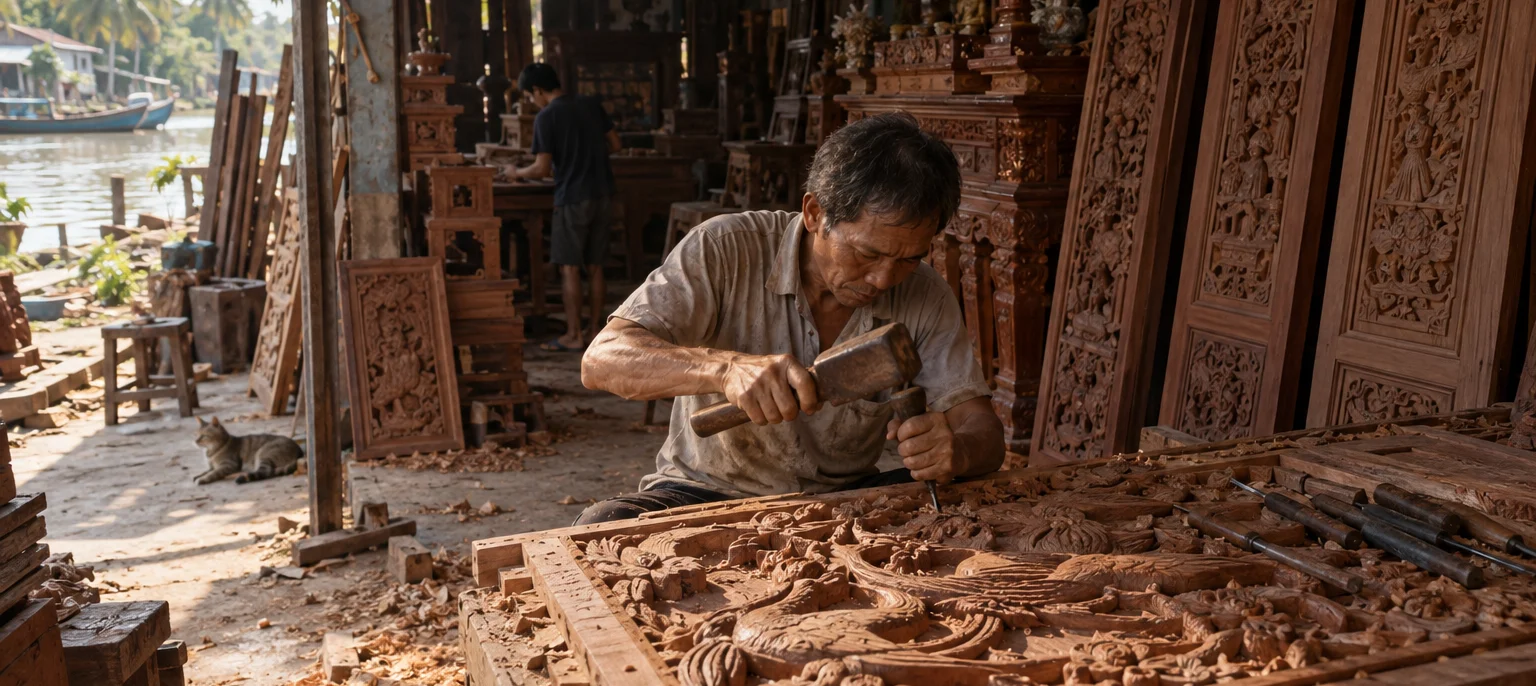
The workshops still work, though what they make has shifted. Much of the output is furniture, and modern machines now rough out work that was once all done by hand. But altars and carved panels are still ordered for new houses and temples, and a carver sitting on the floor of an open workshop, chisels laid out in a row, is still a common sight. The best pieces are often finished with lacquer and gilding, in the warm red and gold the south prefers.
Look at the depth and the undercutting. Good relief carving has layers: leaves in front of branches, birds in front of leaves, with shadows cut in behind. The chisel marks on visible faces should be clean and confident, not furry. In pierced panels, check that thin parts follow the grain so they will not snap. Joinery matters as much as carving; a well-made altar is assembled with wooden joints that close tightly.
02 — The technique
What makes Chợ Mới carving
The carving is planned from the wood outward, and the depth of a panel is decided before the first cut.
I
Choosing the wood
Seasoned hardwood is chosen for close, even grain that will hold fine detail without splitting.
II
Drawing on the board
The design, often flowers, birds or auspicious creatures, is drawn straight onto the wood or transferred from a paper pattern.
III
Relief and piercing
The background is cut away in stages, from bold roughing to fine detail, and openwork is pierced right through.
IV
Finished with colour
Many pieces are lacquered red and gilded, especially altars and the boards that hang above them.
Words you will meet
Chạm nổi
Relief carving, with the design standing out from the background.
Chạm lộng
Pierced or openwork carving.
Bàn thờ
Ancestral altar, the centre of the Vietnamese home.
Hoành phi
Carved horizontal board inscribed with characters, hung above the altar.
03 — Visiting
Visiting Chợ Mới
Chợ Mới is reached by road and ferry from Long Xuyên, and workshops line the roads of several of its communes rather than one single village. Carvers are generally happy to be watched if you keep a respectful distance from their tools. Write to us if you would like an introduction.
- From Cần Thơ
- About two hours by car and ferry
- Best season
- December to April, the dry season
- Look for
- Layered relief with clean chisel marks
The other villages
The full atlas






