Craft village
Chu Đậu
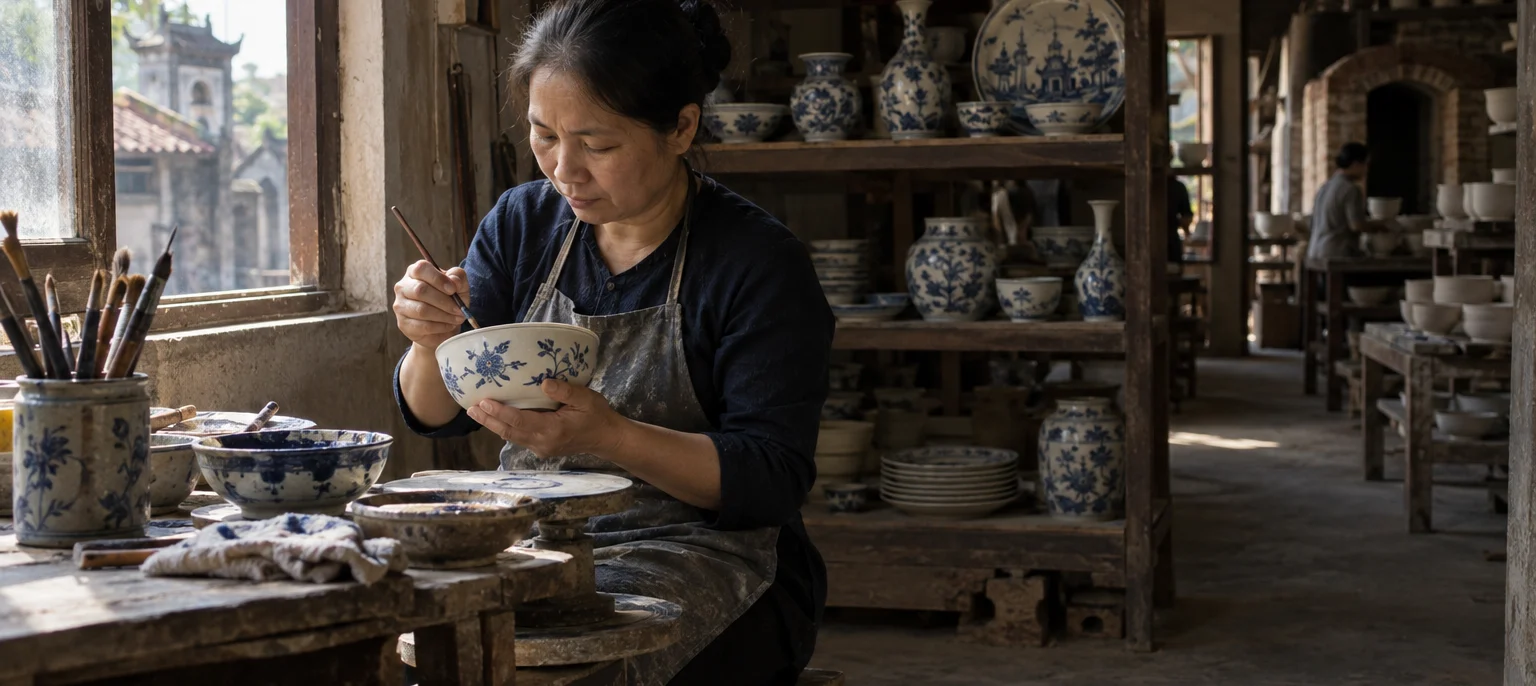
- Craft
- Blue-and-white ceramicsGốm sứ
- Where
- Nam Sách, Hải Dương
- Practised since
- c. 14th centuryRevived in 2001
- Material
- White clay, cobaltUnder a clear glaze
- On LangSoul
- RecordedNot yet carried
01 — The story
Blue-and-white from the river kilns
Chu Đậu stands on the plain of Hải Dương, on waterways that once led to the sea. From the fourteenth to the sixteenth century its kilns made blue-and-white and polychrome ceramics in great quantity: dishes, bottles, jarlets, ewers and figures, painted in cobalt under a clear glaze. The wares were shipped across Southeast Asia and beyond, to the Middle East and Japan. Wars and the closing of the trade ended the kilns, and the village returned to farming. For centuries the pottery was known abroad but its origin was not.
Archaeologists identified the kiln sites in the 1980s, and a wreck off the central coast later yielded a large cargo of Chu Đậu wares. Around 2001 a workshop was established to revive the craft, studying shards from the fields and the museum pieces to recover the clay, the cobalt and the painting. Today the village produces new work in the old manner alongside reproductions of the classic forms, much of it for buyers in Vietnam and abroad.
The old Chu Đậu blue is soft and slightly greyish, not the hard, bright blue of later porcelain, and the glaze has a warm, ivory tone. Painting is quick and confident: peonies, lotus, fish, birds and scrolling vines drawn with few strokes. The body is heavier than Chinese porcelain and often shows a darker foot ring where the glaze stops. In new work, look for the same freedom of brush. Stiff, stencilled painting is a sign of hurry.
02 — The technique
What makes Chu Đậu ceramics
Chu Đậu work is decided by the hand that paints it and by a glaze that softens the blue.
I
A fine white body
The clay is washed and settled until it is fine enough to throw thin walls, then shaped on the wheel or in moulds.
II
Cobalt by brush
The decoration is painted freehand in cobalt oxide on the dry body. The painter has one chance; corrections show.
III
Clear glaze over
A clear glaze is laid over the painting, which fuses the blue into the surface and gives it its soft, blurred edge.
IV
High firing
Pieces are fired at high temperature; the atmosphere in the kiln moves the blue between grey and deep violet-blue.
Words you will meet
Gốm hoa lam
Blue-flower ware, the Vietnamese name for blue-and-white ceramics.
Men
Glaze.
Mảnh gốm
A potsherd; the shards in the fields that guided the revival.
Lò gốm
A pottery kiln.
03 — Visiting
Visiting Chu Đậu
The revived workshop at Chu Đậu welcomes visitors and you can watch throwing, painting and glazing on most weekdays. There is a small display of old shards and finished work; the old kiln sites themselves are farmland. Write to us if you would like an introduction.
- From Hà Nội
- About an hour and a half by car
- Best season
- October to April
- Look for
- Soft, greyish cobalt and quick, confident brushwork
The other villages
The full atlas






