Craft village
Chuông
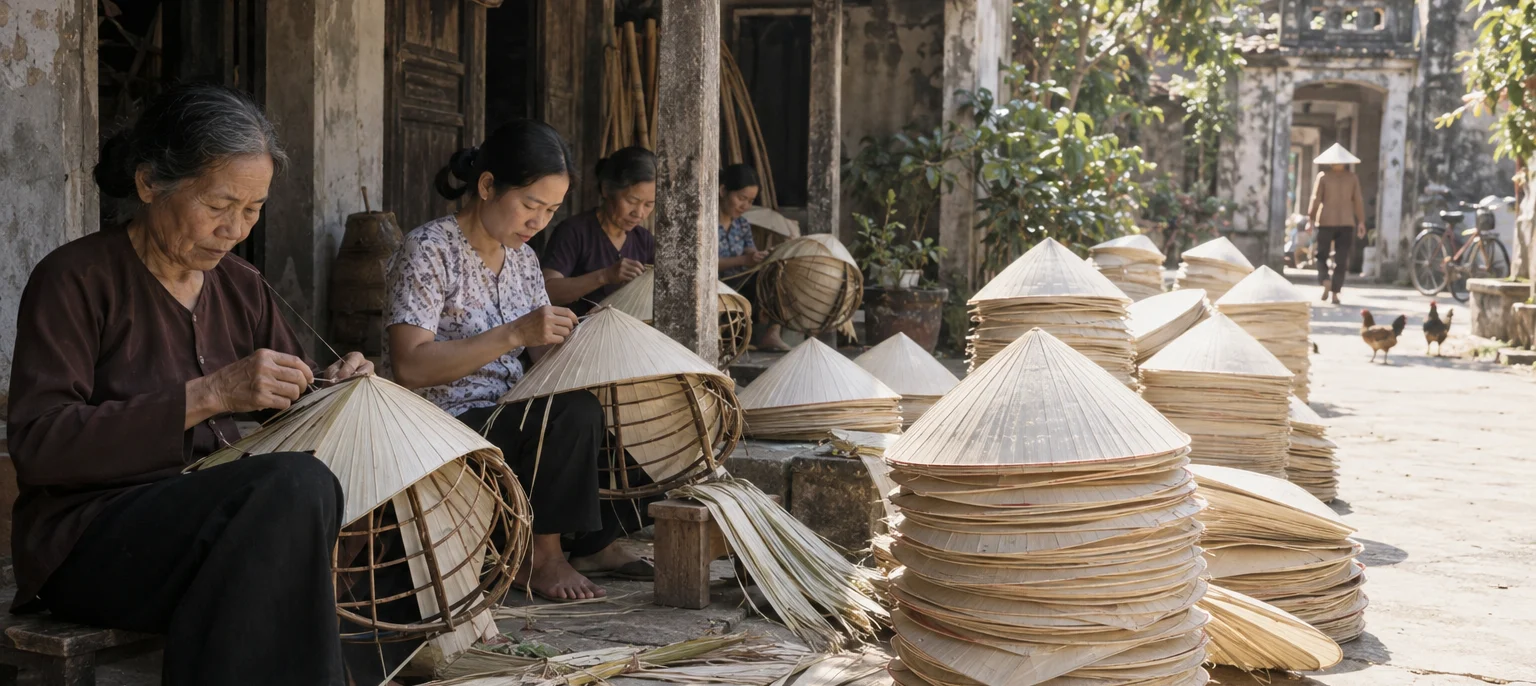
- Craft
- Conical hatsNón lá
- Where
- Thanh Oai, Hà Nội
- Practised since
- c. 300 yearsHat market six times a month
- Material
- Palm leaf, bambooStitched with nylon or silk
- On LangSoul
- RecordedNot yet carried
01 — The story
Three centuries of hats in one yard
Chuông is a village of the Hà Nội plain, south-west of the city, and its name is close to a synonym for the conical hat in the north. For about three hundred years it has made hats for farmers, traders and the women of the delta, along with the finer flat and ribboned hats once worn for festivals. The market still runs on the lunar calendar, on the days ending in four and zero, and it opens early, while the air is cool. Buyers came from across the north, and the hats left the yard by the stack on bicycles and shoulder poles.
Hat-making is household work, and in most homes several generations sit together, one ironing leaves, another shaping rings, another stitching. The leaves come from palm forests in the central provinces and are brought north in bundles. The craft has felt the competition of cheaper hats from elsewhere and of a younger generation leaving for factories, but the market is busy and the village still makes for daily use as well as for visitors and stage.
A good Chuông hat is light, evenly white and perfectly round, and the stitching is so fine and so even that it nearly vanishes into the leaf. Hold it up to the light: the layers should be smooth with no wrinkles, and the rings evenly spaced. The point at the top should be sharp and true. Thick, uneven stitches and a heavy feel point to quick work. Hats made for special occasions sometimes carry thin paper cut-outs or verse between the layers, which show only against the light.
02 — The technique
What makes Chuông hats
A hat is nothing more than leaf, bamboo and thread, and every one of them is prepared by hand.
I
Leaves ironed flat
Palm leaves are dried, then pressed flat with a heated iron over a cloth until they are smooth and pale.
II
Sixteen rings
Thin bamboo is split and shaped into a set of graded rings, and set on a wooden frame to give the cone.
III
Two layers of leaf
Leaves are laid over the frame in two layers, sometimes with a lining of bamboo sheath between, and trimmed to shape.
IV
Stitching that disappears
Each ring is stitched to the leaf with fine thread in tiny, even stitches. A good maker's stitches are almost invisible.
Words you will meet
Nón lá
The leaf hat, the conical hat of Vietnam.
Lá nón
The palm leaf used for hats.
Vành nón
The bamboo rings that hold the shape.
Quai
The chin strap, often a ribbon of silk.
03 — Visiting
Visiting Chuông
Come on a market day and arrive early; by mid-morning most of the trade is done. Away from the market you can watch hats being ironed and stitched in open doorways, but these are working homes, so ask before you photograph or step inside. Write to us if you would like an introduction.
- From Hà Nội
- About an hour by car
- Best season
- Autumn and spring; check the lunar calendar for market days
- Look for
- Near-invisible stitching and even, smooth leaf
The other villages
The full atlas






