Craft village
Đọi Tam
- Craft
- Drum makingTrống
- Where
- Duy Tiên, Hà Nam
- Practised since
- c. 10th centurySince the year 987
- Material
- Jackfruit wood, buffalo hideStretched wet over the frame
- On LangSoul
- RecordedNot yet carried
01 — The story
The drum village under Đọi mountain
Đọi Tam lies in the flat rice country south of Hà Nội, below the small mountain of Đọi Sơn with its old pagoda. According to tradition, when King Lê Đại Hành came to plough the ceremonial furrow here, the villagers made drums to accompany him, and the trade has been the village’s ever since. For centuries Đọi Tam supplied the communal houses, pagodas and festivals of the north with drums of every size, from small hand drums to the great drums of the village gate.
Most households still make drums, and the sound of tuning carries along the lanes. Demand comes from temples, schools, festivals and performing troupes, and from the many communities that commission a large drum when they restore their communal house. Some makers now use machine tools for the staves and source hides more widely, but the stretching and tuning are still done by ear. Large festival drums can take weeks to finish and are often delivered by truck with the makers riding alongside to fit them.
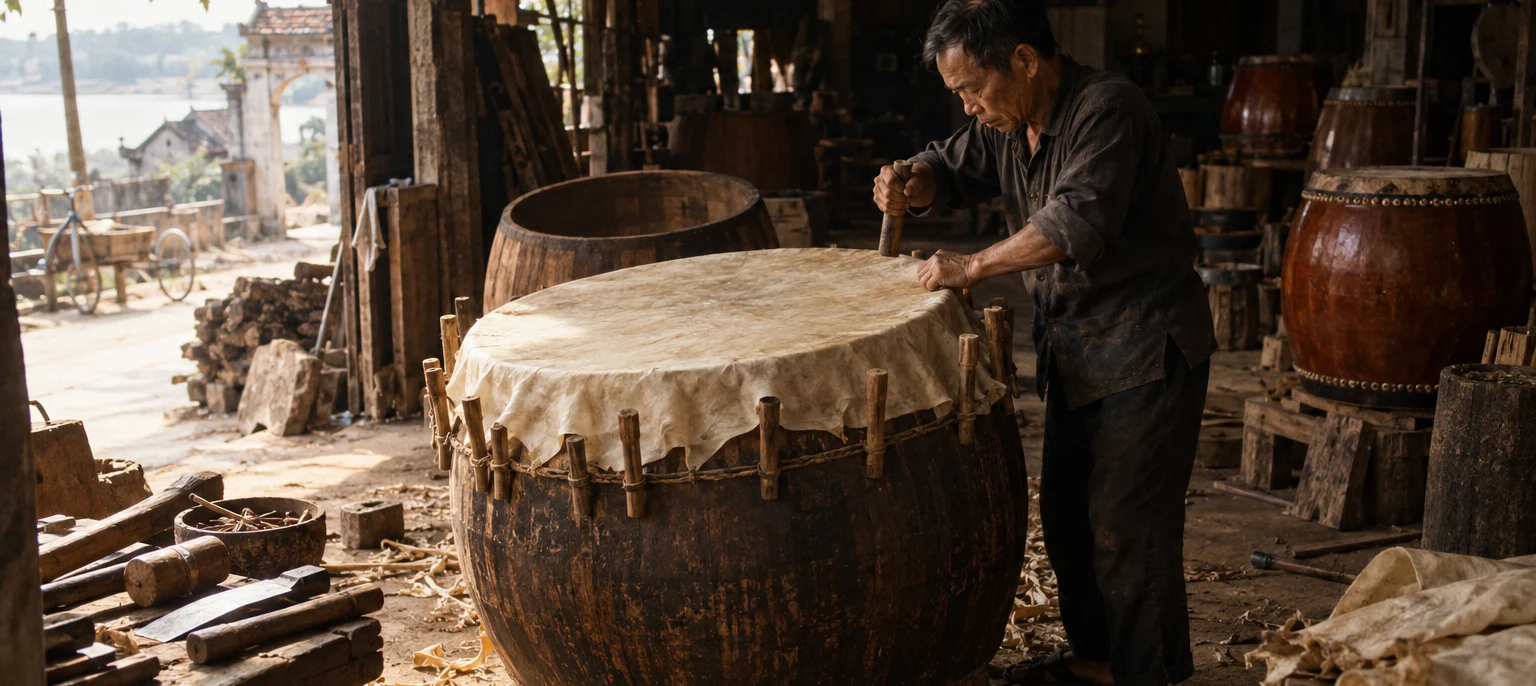
A good drum is judged by its sound first. It should speak clearly and sustain, with no buzz or dull spot when struck at different points. The staves should fit so closely that the joints are barely visible, and the body should be evenly curved. The hide should be stretched taut and even, and the pegs set in a neat, close line around the rim. Jackfruit wood darkens with age to a warm brown, and a well-made drum is meant to be played for decades and re-headed when the hide finally wears.
02 — The technique
What makes Đọi Tam drums
The body is carpentry and the head is leatherwork, but a drum is finished only when it sounds right.
I
Jackfruit staves
The body is made of jackfruit-wood staves, shaped and fitted edge to edge, then bound with hoops into a curved barrel.
II
Buffalo hide
Hide is soaked, scraped thin and dried, then soaked again so it can be worked.
III
Stretched wet
The wet hide is stretched over the body and fixed with bamboo pegs. As it dries it tightens and draws the pitch up.
IV
Tuned by ear
The maker strikes the head, adjusts the tension and shaves the hide where needed, until the drum gives the note the buyer wants.
Words you will meet
Trống
Drum.
Tang trống
The wooden body of the drum.
Mặt trống
The drumhead.
Da trâu
Buffalo hide.
03 — Visiting
Visiting Đọi Tam
You will hear the village before you see it. Workshops are open-fronted, and the makers are used to visitors who want to watch hide being stretched or a drum being tuned. Ask before striking a drum that is not yours, and climb Đọi Sơn for the pagoda and the view. Write to us if you would like an introduction.
- From Hà Nội
- About an hour and a half by car
- Best season
- Before the spring festival season, from December to February
- Look for
- Tight joints, a taut even head and a clean, sustained tone
The other villages
The full atlas






