Craft village
Đông Hồ
- Craft
- Folk woodblock printsTranh dân gian
- Where
- Thuận Thành, Bắc Ninh
- Practised since
- c. 17th centuryTết prints for the north
- Material
- Dó paper, shell whitePigments from leaves, soot and shell
- On LangSoul
- RecordedNot yet carried
01 — The story
The village that printed the New Year
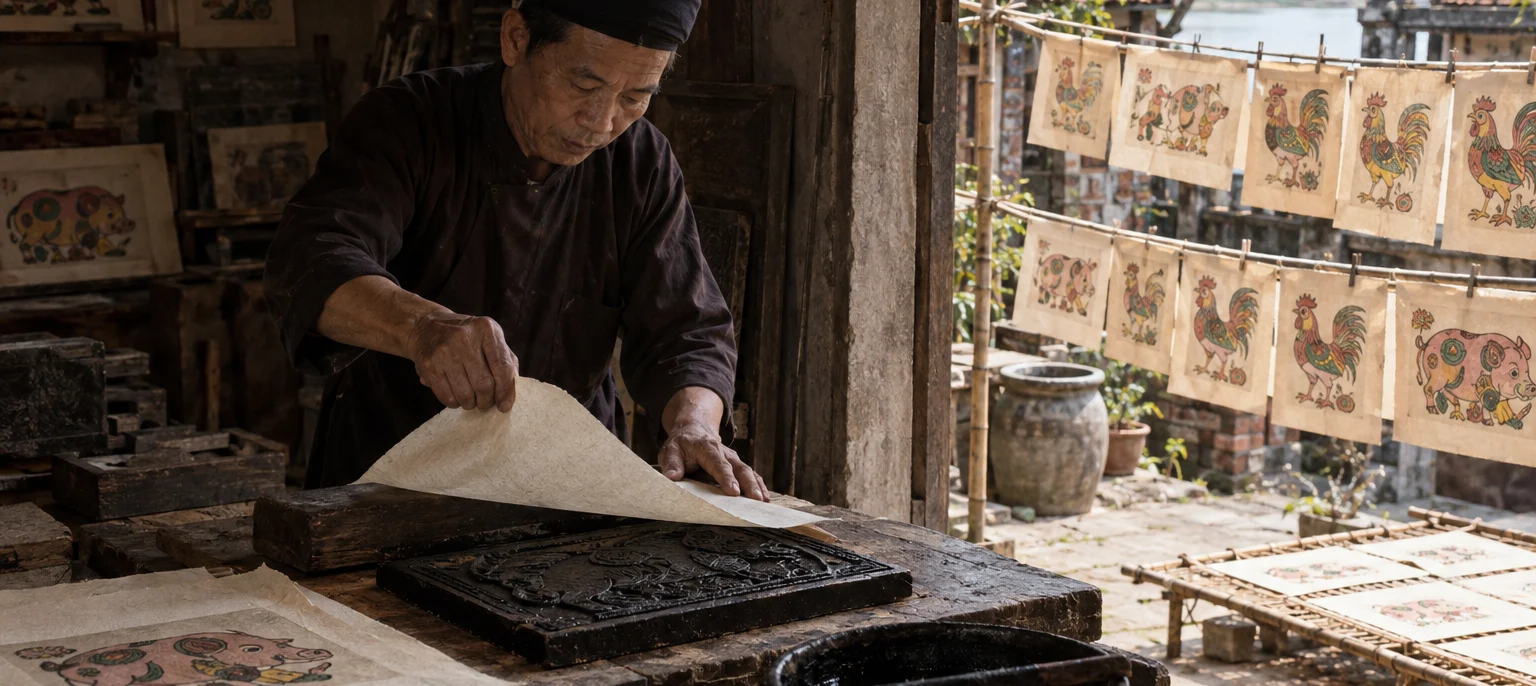
Đông Hồ lies on the south bank of the Đuống river, in the old Kinh Bắc country east of Hà Nội. Its prints were made for the lunar new year: a fat pig with a whorl on its flank, a carp leaping, children with a toad, the mouse wedding with its procession and its cat. In the last month of the lunar year the village held a market for prints alone, and traders carried them by boat and on shoulder poles across the delta. The pictures were cheap, cheerful and meant to be replaced every year.
The trade fell away in the twentieth century, as calendars and printed posters took over the walls. Most of the village now makes votive paper for burning at festivals. A few families have kept the blocks and the paper, and they print for collectors, museums and visitors more than for the Tết market. Some blocks in use are old and handed down; others are recut from old prints by the families who still carve.
In a good print the paper is the first thing to notice. Real dó paper coated in điệp has a faint sparkle when tilted to the light, and a slightly raised, grainy surface where the shell lies thick. The colours sit flat and a little chalky, never glossy, and each sits slightly off the next, because every colour is a separate block laid down by hand. The black line is crisp and goes on last. Prints on smooth white paper with bright synthetic colour are souvenirs, not Đông Hồ work.
02 — The technique
What makes Đông Hồ prints
Every colour is a separate block and a separate pressing, built up on paper that has been prepared before any ink touches it.
I
Paper coated in shell
Dó paper is brushed with a paste of ground scallop shell and rice glue, often with a broom of pine needles, which leaves fine parallel streaks in the white.
II
Colours from the land
Black comes from burnt bamboo leaves, red from a red earth, yellow from sophora flowers, and blue-green from indigo or leaves. None of them shine.
III
One block for each colour
The colour blocks are inked and pressed one after another, the sheet laid face down on the block and rubbed by hand, with drying time between.
IV
The line block last
The black outline block goes on last and pulls the picture together. A good printer lands it squarely over the colour without smudging.
Words you will meet
Tranh dân gian
Folk painting; in practice, the woodblock prints sold at Tết.
Giấy dó
Paper made from the inner bark of the dó tree, soft and long-fibred.
Điệp
Powdered scallop shell, mixed with glue to give the paper its shimmering white ground.
Ván in
The carved woodblock from which a print is pressed.
03 — Visiting
Visiting Đông Hồ
The printing families work year round, but the weeks before Tết are when the village feels most like itself. Expect to see blocks, paper being coated and prints being pressed in one or two houses, with votive-paper workshops all around. Ask before photographing inside a house, and buy from the printers directly; write to us if you would like an introduction.
- From Hà Nội
- About an hour by car
- Best season
- The month before Tết, or the dry months from October to April
- Look for
- Shell-white paper that sparkles when tilted, and slightly misaligned colours
The other villages
The full atlas






