Craft village
Hương Canh
- Craft
- Unglazed stonewareGốm sành
- Where
- Bình Xuyên, Vĩnh Phúc
- Practised since
- c. 300 yearsBlue-grey clay of one place
- Material
- Blue-grey clayUnglazed, high-fired
- On LangSoul
- RecordedNot yet carried
01 — The story
The stoneware that breathes
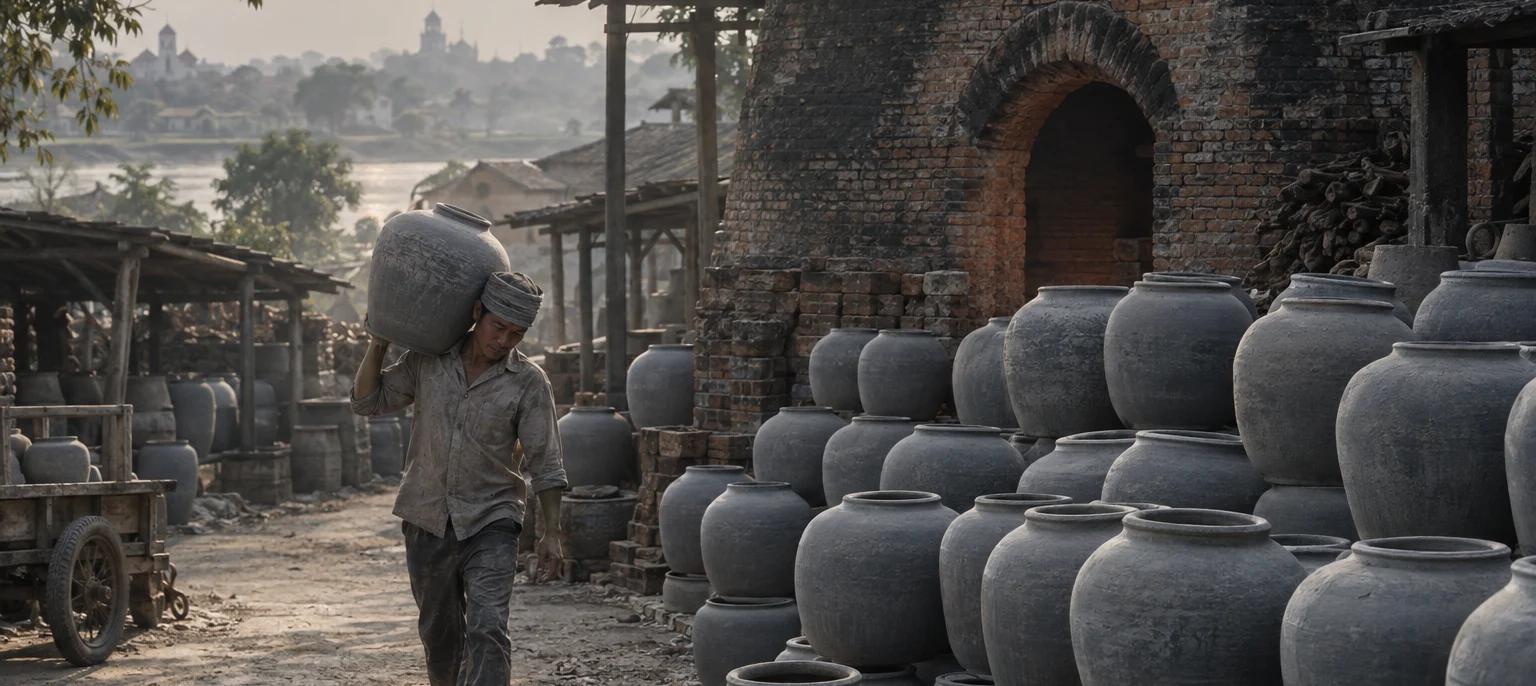
Hương Canh lies in the midland country north-west of Hà Nội, where the delta gives way to low hills. The clay found around the village fires to a dense, grey-blue stoneware without any glaze, and for about three centuries the village has used it to make the large vessels of rural life: jars for rice and water, vats for fish sauce and pickles, pots, pipes and burial urns. The vessels were said to keep water cool and food fresh, because the walls breathe a little.
The demand for big jars fell with plastic and steel, and many kilns closed. Some families now make flowerpots, garden ware, tiles and decorative pieces, and a few artists have begun working with the clay. A handful of kilns are still wood-fired in the old way, which gives the most interesting surfaces, while others have moved to gas. Old Hương Canh jars have also found a new market among collectors and restaurants. The clay pits themselves are shrinking as the town around the village grows, which makes the remaining old jars more valued.
Good Hương Canh stoneware is heavy and hard, and rings clearly when you tap it with a knuckle. The surface should be smooth and slightly lustrous, its colour shifting from blue-grey to brown where the flame touched it. Without glaze, there is nowhere to hide a weak body, so look for walls that are even in thickness and free of cracks, especially around the shoulder and base. Fire marks and slight warping on wood-fired pieces are part of their character, not faults.
02 — The technique
What makes Hương Canh stoneware
Without glaze, the clay and the fire have to do all the work.
I
Clay of one place
The local clay is dug, aged and trodden until it is plastic and even, and it is rarely mixed with clay from elsewhere.
II
Shaped on the wheel
Large vessels are thrown on a slow wheel, often turned by a helper, and built up in stages as the walls firm.
III
No glaze
The pieces go into the kiln bare. The sheen on the surface comes from the clay itself at high temperature.
IV
A long, hot fire
A wood firing lasts days and reaches the heat at which the body vitrifies, closing the pores and giving it its ring.
Words you will meet
Gốm sành
Stoneware, fired hard and dense.
Chum
A large jar for storing rice or water.
Vại
A wide vat, for pickles or fish sauce.
Lò
A kiln.
03 — Visiting
Visiting Hương Canh
The kilns are scattered among the houses and you will see stacks of jars and pots in yards along the lanes. Firings are irregular and the kilns are hot and busy, so keep your distance and ask before entering. Write to us if you would like an introduction.
- From Hà Nội
- About an hour by car
- Best season
- October to April
- Look for
- A clear ring when tapped and blue-grey colour shading to brown
The other villages
The full atlas






