Craft village
Lái Thiêu
- Craft
- CeramicsGốm
- Where
- Thuận An, Bình Dương
- Practised since
- c. 19th centuryEveryday ware of the south
- Material
- Clay, coloured glazesBrush-decorated
- On LangSoul
- RecordedNot yet carried
01 — The story
Roosters on the rice bowl
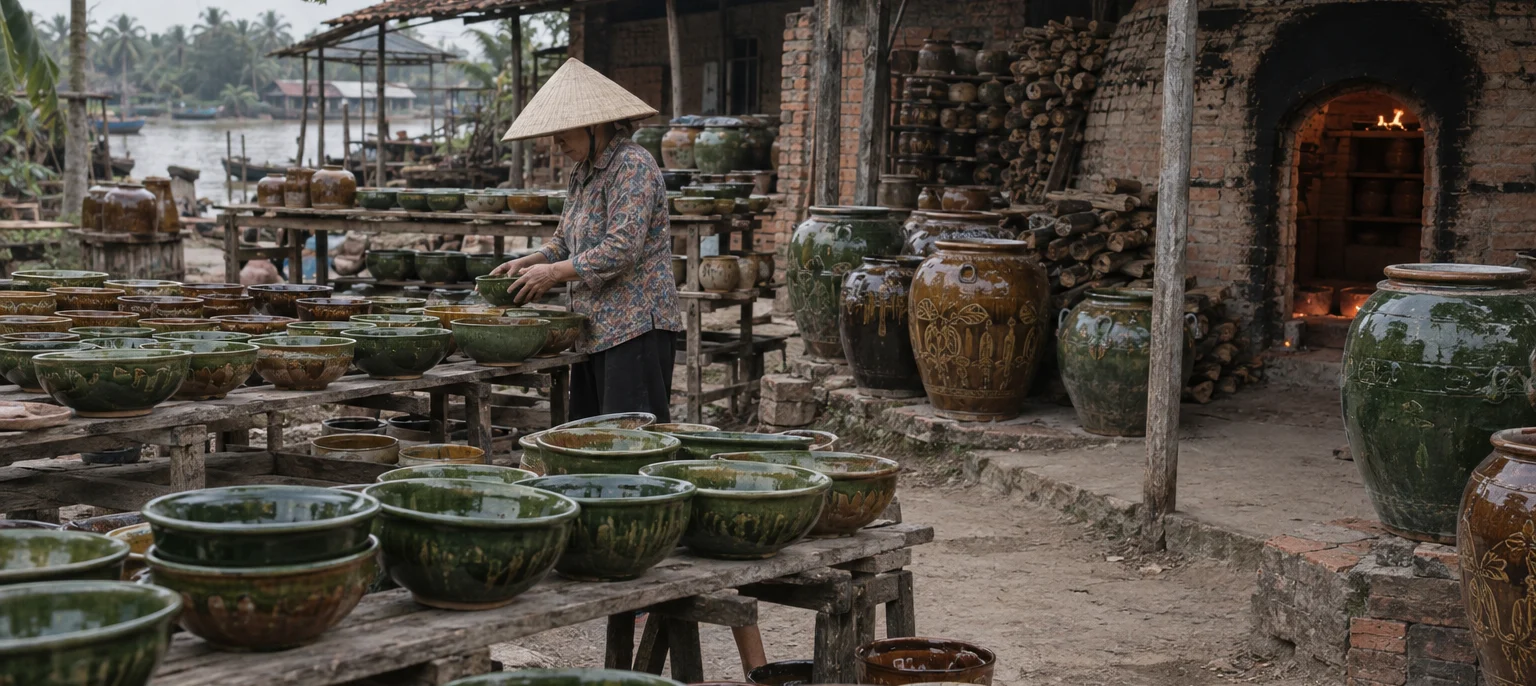
Lái Thiêu grew up as a river town north of Sài Gòn, famous for its orchards as much as its kilns. Chinese potters, many of them Hakka and Teochew, settled here in the nineteenth century, drawn by good clay and by the river that carried their wares downstream to the markets. They built long climbing kilns and made what the south needed every day: rice bowls, plates, jars, teapots and the large glazed basins of the kitchen.
The best-known Lái Thiêu piece is the humble rooster bowl, a rooster brushed quickly in red, green and black beside a banana leaf or a peony. Generations of southern families ate from these bowls, and they are now collected for that reason. Today the old kilns have mostly moved or closed as the town has grown, and much production has shifted to larger factories in Bình Dương. A few family workshops still throw, brush and fire in the older way, and the town’s ceramic history is still easy to read in its streets and temples.
Look for confident, unfussy brushwork: a rooster painted in a few strokes by someone who has painted thousands. The glazes are bright but should not look printed. Turn a bowl over and you will often find an unglazed foot ring and a little roughness where it sat in the kiln. Slight unevenness in the rim, a drip of colour, a stacking mark inside the bowl are the signs of real use-ware, not faults.
02 — The technique
What makes Lái Thiêu ceramics
This is everyday ware, and its character comes from speed, repetition and a sure hand with the brush.
I
Local clay
Clay from the Bình Dương area is washed, aged and wedged before it is thrown or pressed in moulds.
II
Painted freehand
Roosters, flowers and leaves are brushed on quickly in a few colours, each painter keeping to a small set of motifs.
III
Bright glazes
Coloured glazes in green, yellow and blue cover jars and basins, often over simple incised or moulded decoration.
IV
Fired in the long kiln
Pieces are stacked in long dragon kilns built up a slope and fired for a long day and night with wood.
Words you will meet
Gốm
Ceramics, pottery in general.
Chén con gà
The rooster bowl, the emblem of Lái Thiêu ware.
Men
Glaze.
Lò rồng
The dragon kiln, a long tunnel kiln climbing a slope.
03 — Visiting
Visiting Lái Thiêu
Lái Thiêu is now part of a busy town, so come for the old temples and the remaining family workshops rather than for a village atmosphere. Workshops welcome buyers but are working places; call ahead or ask locally which are open. Write to us if you would like an introduction.
- From Hồ Chí Minh City
- About 45 minutes by car
- Best season
- December to April, the dry season
- Look for
- Freehand brushwork and an unglazed foot ring
The other villages
The full atlas






