Craft village
Làng Sình
- Craft
- Folk woodblock printsTranh dân gian
- Where
- Phú Vang, Huế
- Practised since
- c. 400 yearsPrints for the altar
- Material
- Dó paper, woodblocksColoured by hand
- On LangSoul
- RecordedNot yet carried
01 — The story
Prints that are made to be burned
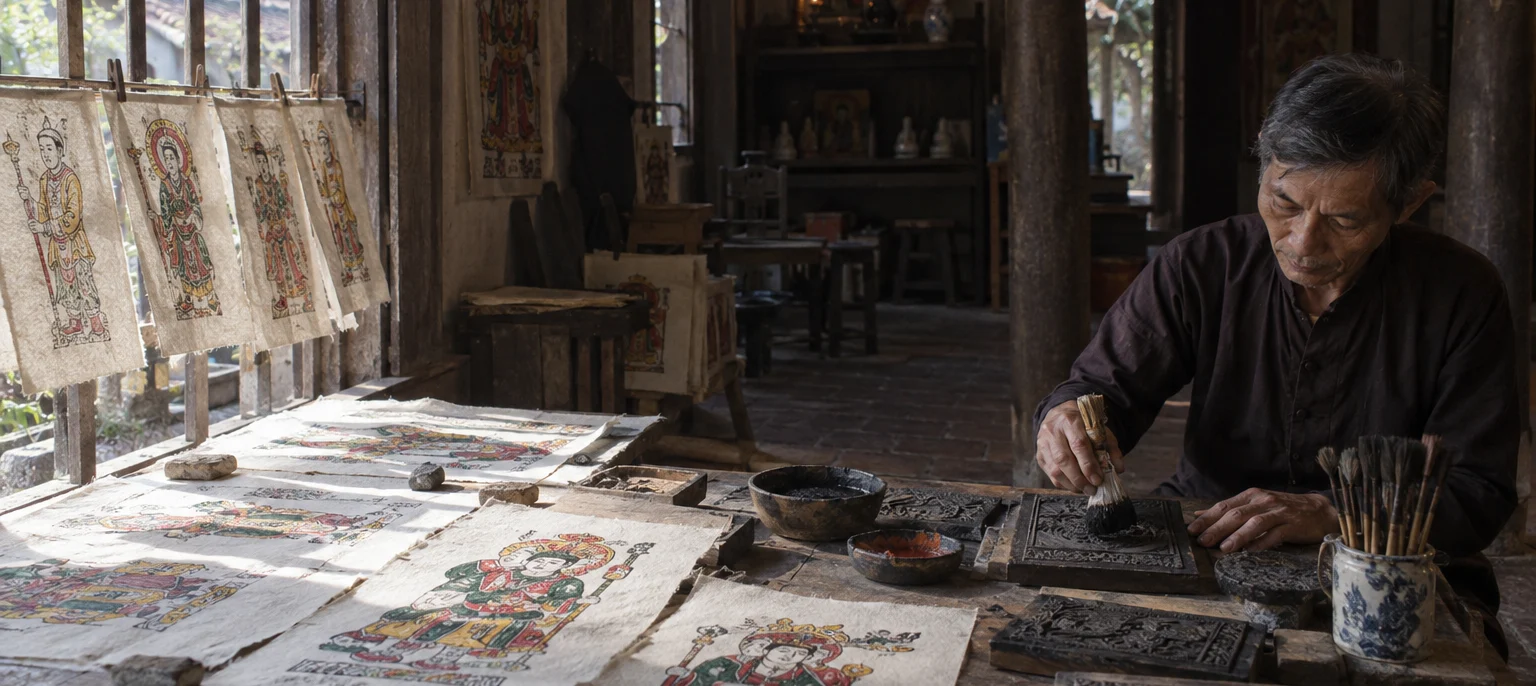
Sình is the local name for Lại Ân, a village on the Hương river a short way downstream from Huế. For around four hundred years it has printed the figures used in household and village rituals: guardian spirits, the kitchen god, horses and elephants for the ancestors, paper clothing and the symbolic stand-ins that are offered in place of the living. The print is placed on the altar, the prayer is said, and the paper is burned so that it reaches the other world. Very few old prints survive for that reason; the woodblocks are the archive.
The craft came close to vanishing in the twentieth century as rituals changed and cheap printed paper arrived. It was revived by a small number of families who kept the blocks and the knowledge of colour, and the prints are now also made as pictures to keep, alongside the ritual work. The busiest time is the run-up to Tết, when households across the Huế region renew their altars. The village is also known for its wrestling festival early in the lunar new year.
A good Sình print has a clean, confident black line and colour laid on quickly by brush, slightly outside the line in places. The palette is small and warm: reds, yellows, greens and black. The paper should be soft dó, not machine card. Look for the slight variation from sheet to sheet that hand colouring gives.
02 — The technique
What makes Làng Sình woodblock prints
Unlike Đông Hồ, Sình prints only the outline from the block; the colour is the painter's work.
I
Carved blocks
The outlines are carved in reverse on blocks of hardwood, many of them handed down within families for generations.
II
Printed in black
The block is inked and the dó paper pressed onto it by hand, giving a single black outline per sheet.
III
Coloured by brush
Colour is brushed on by hand in a few quick strokes, so each print in a batch is slightly different.
IV
Made for ritual
Sizes, figures and colours follow the needs of particular ceremonies, which is why the repertoire is so specific.
Words you will meet
Tranh thờ
Altar or worship pictures, used in ritual.
Giấy dó
Paper made from the bark of the dó tree, soft and strong.
Bản khắc
A carved printing block.
Hóa vàng
The burning of paper offerings at the end of a ceremony.
03 — Visiting
Visiting Làng Sình
Làng Sình is small and close to Huế, and only a few households print, so it helps to go with an introduction. The weeks before Tết are the most interesting and the busiest; outside them you may find printing on request rather than in full swing. LangSoul does not run trips here, but readers can write to us for an introduction.
- From Huế
- About 20 minutes by car, 8 km downstream
- Best season
- The month before Tết and the first lunar month
- Look for
- Soft dó paper, a crisp black line and brushed colour
The other villages
The full atlas






