Craft village
Lùng Tám
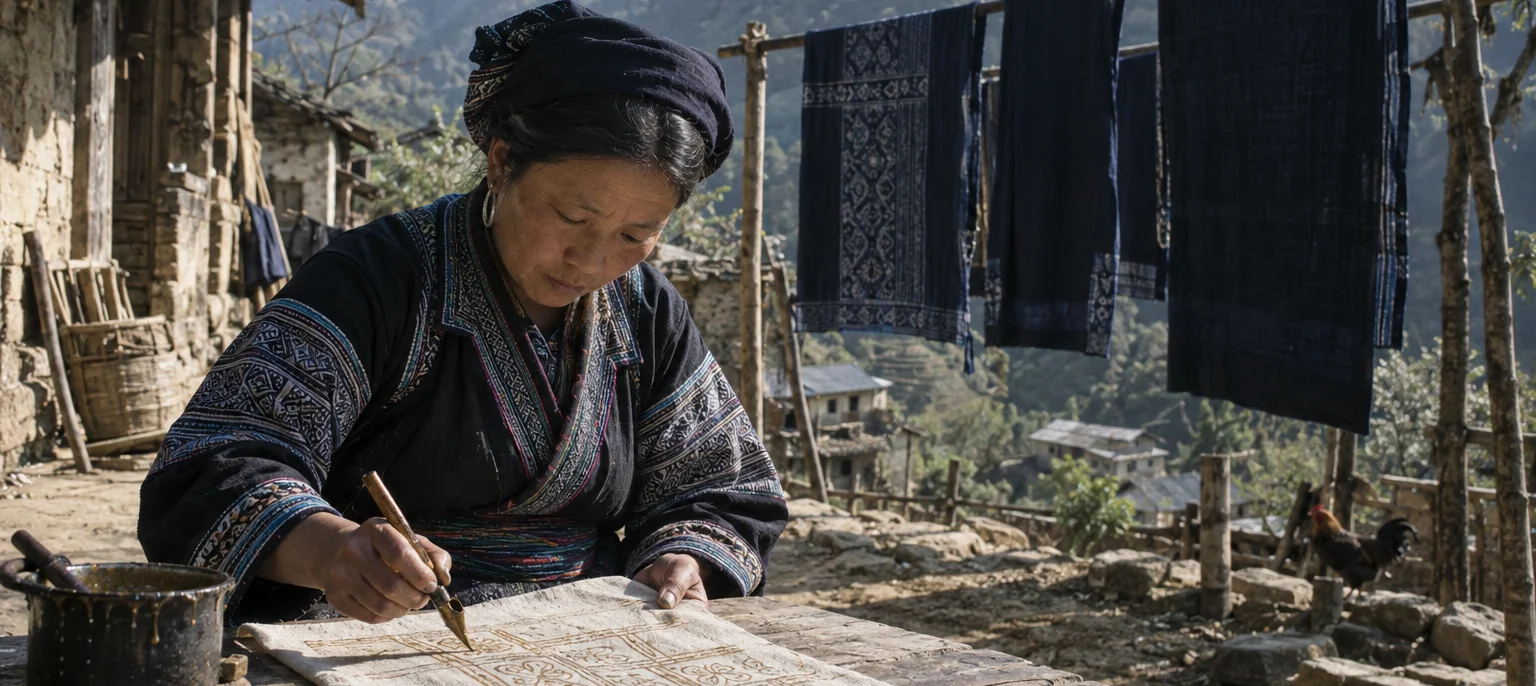
- Craft
- Hemp, indigo & beeswax batikLanh, chàm
- Where
- Quản Bạ, Hà Giang
- Practised since
- GenerationsHemp from seed to cloth
- Material
- Hemp, indigo, beeswaxBatik and embroidery
- On LangSoul
- RecordedNot yet carried
01 — The story
Hemp from seed to indigo cloth
Lùng Tám lies in a valley of Quản Bạ, in the limestone highlands of Hà Giang, close to the border with China. The H’Mông families here grow hemp on small plots and turn it into cloth for skirts, jackets and the clothes of ceremonies and funerals. Hemp has a place in H’Mông belief as well as in daily life, and many people expect to be buried in hemp clothing. The plant grows quickly on thin mountain soil, and the stalks are harvested in summer.
Weaving is women’s work, and every stage happens near the house: hemp drying on fences, yarn being joined by hand while walking or talking, a loom in a corner, an indigo vat in the yard. In recent years a cooperative has helped families sell their cloth, bags and scarves to visitors and to designers in the cities, and the village has become a stop for travellers on the Hà Giang loop. Much of the clothing worn day to day, however, is now bought, and the full hemp process is kept up by a dwindling number of women.
Good Lùng Tám cloth is firm and slightly irregular, with joins visible in the yarn. Hand-spun hemp softens with use and washing. The indigo should be deep and even, and the batik lines crisp, with fine geometric motifs and spirals drawn in beeswax. Look for the shadow of the wax in indigo, where the white line is slightly blurred.
02 — The technique
What makes Lùng Tám hemp cloth
Making hemp cloth by hand takes almost a year, and much of the time goes into the fibre before any weaving.
I
Fibre by hand
Hemp stalks are dried, and the bark stripped and split into fibres, which are joined end to end by hand into a single thread.
II
Softened
The yarn is boiled with wood ash and pressed under a heavy roller until it softens and whitens.
III
Drawn in wax
Patterns are drawn on the woven cloth with melted beeswax, using a small metal-tipped pen, before the cloth goes into the dye.
IV
Dyed in indigo
The cloth is dipped repeatedly in an indigo vat and dried between dips, then boiled to remove the wax and reveal the pattern.
Words you will meet
Lanh
Hemp, the fibre and the cloth.
Chàm
Indigo, the plant and the dye.
Sáp ong
Beeswax, used for drawing batik patterns.
Hợp tác xã
Cooperative, through which many villages sell their cloth.
03 — Visiting
Visiting Lùng Tám
Lùng Tám is a short detour from the main road through Quản Bạ, and the weaving cooperative is the easiest place to see the full process. In family houses, ask before photographing anyone and buy directly from the weaver if you can. Write to us if you would like an introduction.
- From Hà Giang
- About an hour and a half by road
- Best season
- September to November, after the rains
- Look for
- Hand-joined yarn, deep indigo and crisp beeswax lines
The other villages
The full atlas






