Craft village
Mai Châu
- Craft
- Thái brocade weavingThổ cẩm
- Where
- Hòa Bình
- Practised since
- GenerationsLooms under every house
- Material
- Cotton and silkPlant dyes
- On LangSoul
- RecordedNot yet carried
01 — The story
A loom under every house
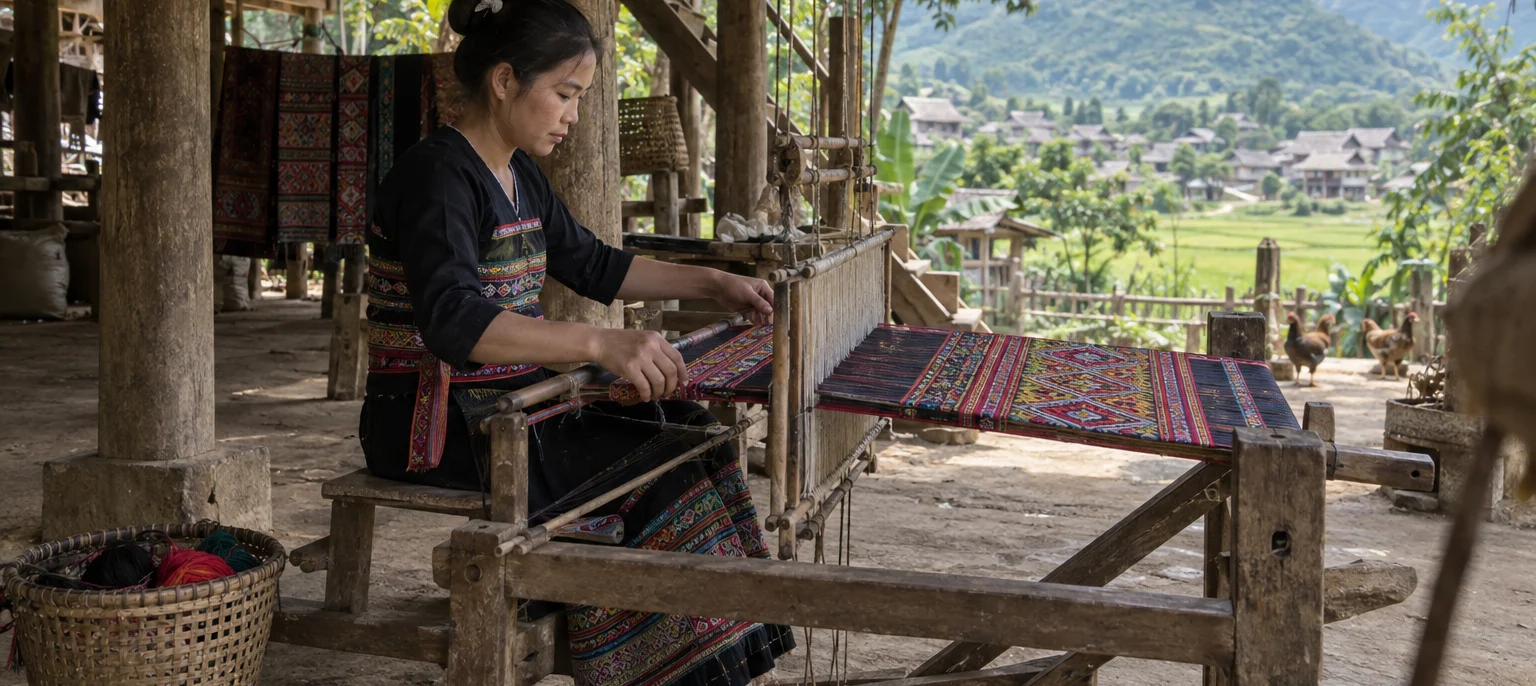
Mai Châu is a broad valley of rice fields in the hills south-west of Hà Nội, and the White Thái villages along its floor still build their houses on stilts. The space beneath is for tools, animals and the loom. Women have woven there for generations, making the cloth for skirts and the brocade bands at their waists, as well as blankets, pillows and scarves for the household and for marriage gifts. Girls learned at the loom young, and a bride’s skill was once judged by the blankets and pillows she brought to her husband’s house.
The valley has been open to visitors for decades, and villages such as Bản Lác and Pom Coọng now host homestays and sell textiles along their lanes. Some families still weave by hand, but much of what is on sale is machine-made or brought in from elsewhere, so it is worth asking and looking closely. Weaving survives most strongly where it is made for use, for weddings and for the household, rather than for sale. Silk and cotton are still grown and spun by a few households, though most yarn is now bought.
Good Mai Châu brocade is dense and even, with the pattern clear on the front and a tidy back. Hand-woven pieces show slight irregularities in the width and in the repeats. The geometric motifs, diamonds, hooks and stylised flowers and animals, should be crisp. Plant-dyed colours are softer than synthetic ones and fade slowly into a warmer tone.
02 — The technique
What makes Mai Châu brocade
Brocade is woven, not embroidered: the pattern is built into the cloth thread by thread.
I
Cotton and silk
The base is cotton, sometimes with silk; the yarn is spun and dyed before weaving, using plant dyes where the weaver still keeps them.
II
A floor loom
Weaving is done on a wooden loom under the house, with a warp set up by hand.
III
Patterns lifted by hand
The pattern is woven with extra coloured threads, the weaver picking up warp threads in sequence for each row.
IV
Patterns from memory
Weavers carry their motifs in their heads, learned from mothers and grandmothers.
Words you will meet
Thổ cẩm
Brocade, the patterned cloth of the upland peoples.
Khung cửi
A loom.
Cạp váy
The brocade waistband of a Thái skirt.
Nhà sàn
A stilt house.
03 — Visiting
Visiting Mai Châu
Stay in a homestay and walk or cycle out to the quieter villages beyond Bản Lác, where you are more likely to find someone weaving. Ask before photographing people at their looms, and buy directly from the weaver if you can. Write to us if you would like an introduction.
- From Hà Nội
- About three and a half hours by road
- Best season
- May to June or September to October, when the rice is green or gold
- Look for
- Dense brocade with a tidy back and slight hand irregularities
The other villages
The full atlas






