Craft village
Mỹ Nghiệp
- Craft
- Cham brocadeDệt Chăm
- Where
- Ninh Phước, Ninh Thuận
- Practised since
- GenerationsBackstrap looms
- Material
- Cotton and silkPlant and mineral dyes
- On LangSoul
- RecordedNot yet carried
01 — The story
Patterns counted in memory
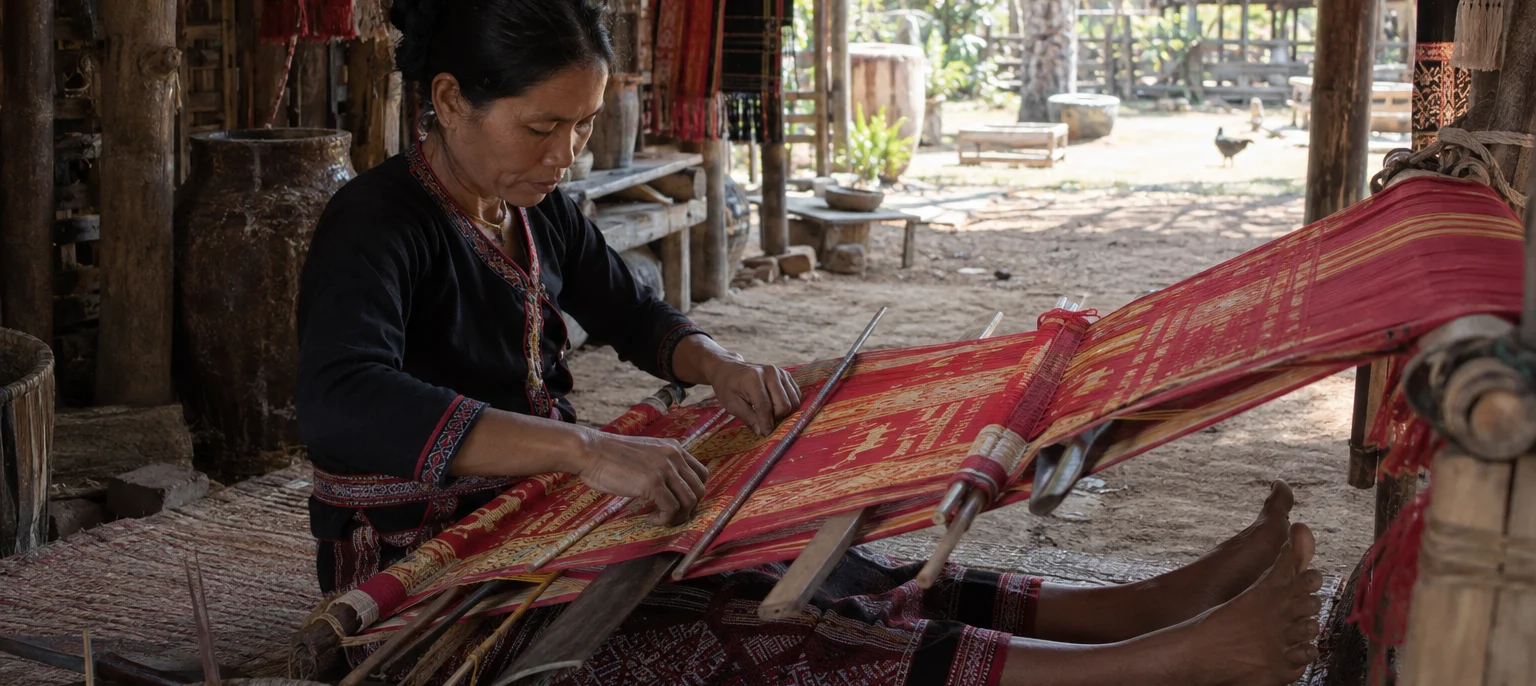
Mỹ Nghiệp is a Cham village in Ninh Thuận, close to Bàu Trúc and a short way from Phan Rang. Cham weaving here is old, and the cloth has long been part of Cham life: clothing for daily wear, sashes and shawls, and textiles for weddings, funerals and the ceremonies at the temple towers. Women weave, and girls traditionally learned at home, sitting beside their mothers until the patterns became familiar.
Today the village weaves on two kinds of loom. The narrow backstrap loom, tensioned by the weaver’s own body, is used for the most traditional pieces, and larger frame looms are used for wider cloth and for the bags, scarves and runners that are sold to visitors and shops. Commercial cotton and synthetic yarns with chemical dyes are now common, and plant and mineral dyes are kept by fewer weavers. A cooperative and family workshops in the village show and sell the work. A single wide piece can take a weaver many days, and complex patterns are slower still, which is worth remembering when comparing prices. Most weavers fit the work around farming and family.
Good Mỹ Nghiệp brocade has dense, even weaving with tight selvedges, and patterns that line up across repeats without drift. The traditional motifs, including flowers, diamonds, dragons and stylised temple towers, should be crisp. Natural-dyed cloth has softer, slightly uneven colour, and it is worth asking which you are looking at.
02 — The technique
What makes Mỹ Nghiệp Cham brocade
The pattern is not drawn anywhere; it lives in the weaver's counting.
I
Dyeing the yarn
Yarn is dyed before weaving, traditionally with plants, bark and earth; today often with commercial dyes.
II
Backstrap loom
The warp is stretched between a fixed bar and a strap around the weaver's back, who controls tension by leaning.
III
Supplementary weft
Patterns are made by passing extra coloured threads over and under counted warp threads, row by row.
IV
Held in memory
Motifs are counted from memory, and each weaver has a repertoire learned from the women of her family.
Words you will meet
Thổ cẩm
Brocade, patterned handwoven cloth of Vietnam's minority peoples.
Dệt
To weave.
Khung dệt
Loom.
03 — Visiting
Visiting Mỹ Nghiệp
Mỹ Nghiệp is easily paired with Bàu Trúc in a single morning from Phan Rang. Weavers are usually happy to show the loom; ask before photographing and buy directly from the woman who made the piece when you can. LangSoul does not run trips here, but readers can write to us for an introduction.
- From Phan Rang
- About 20 minutes by car
- Best season
- December to August; the Katê festival falls in autumn
- Look for
- Tight selvedges, even repeats and, if you can find it, natural dye
The other villages
The full atlas






