Craft village
Ngũ Xã
- Craft
- Bronze castingĐúc đồng
- Where
- Ba Đình, Hà Nội
- Practised since
- c. 17th centuryFive villages, one quarter
- Material
- BronzeCast for the court and the pagodas
- On LangSoul
- RecordedNot yet carried
01 — The story
A casting village inside the capital
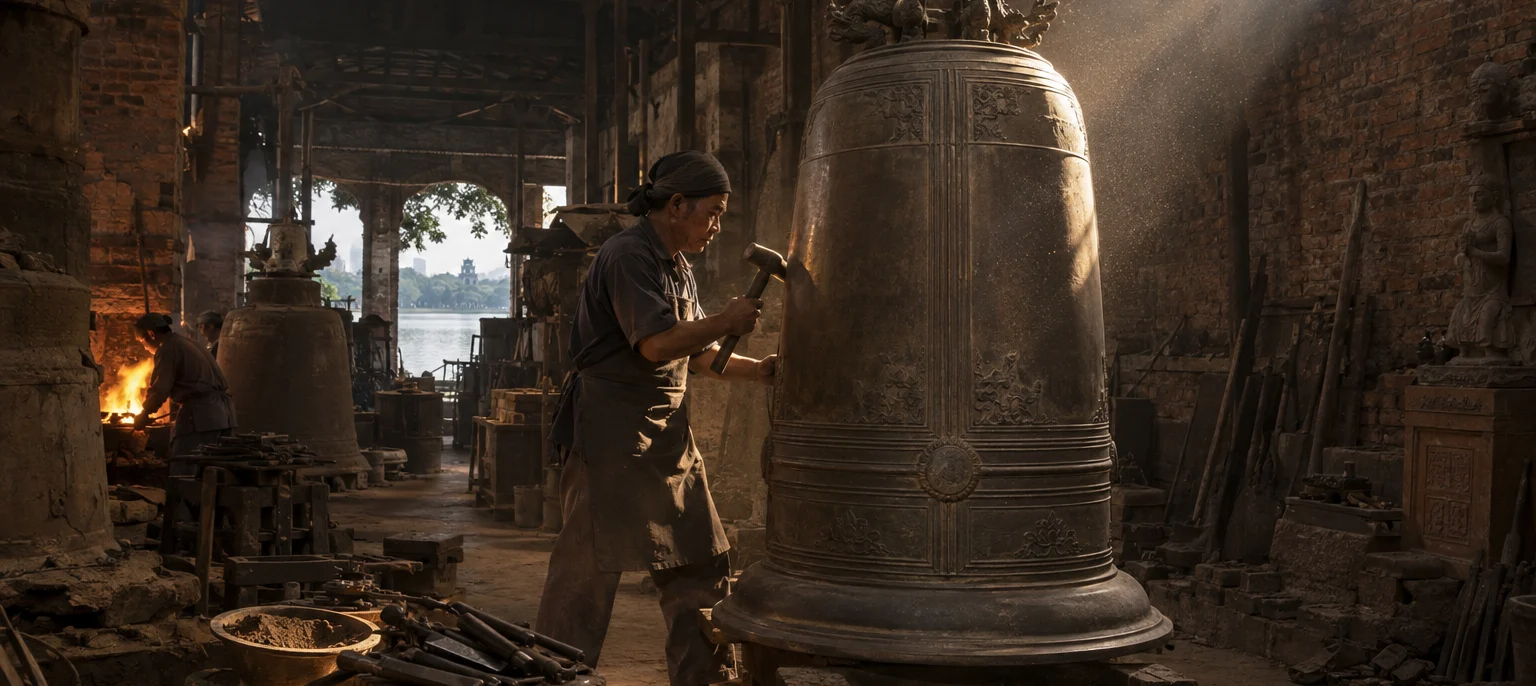
Ngũ Xã sits on the shore of Trúc Bạch lake, a few minutes from West Lake in the centre of Hà Nội. The casters who settled here came from five bronze-working villages and kept the name, five villages, for the quarter they built. They cast for the court and for the pagodas: bells, incense burners, statues, ritual vessels and the domestic bronze of well-off households. They honour Nguyễn Minh Không, the Lý-dynasty monk whom Vietnamese casters regard as the patron of their craft.
The best-known work stands in the village itself. The great bronze Buddha of Thần Quang pagoda was cast by the villagers in a single pour, and it is still the reason most visitors come. The city has grown around Ngũ Xã since, and casting in a dense residential quarter has become difficult; much of the heavy work now takes place in workshops beyond the centre, while the lanes are known for bronze shops and for food. A few families keep the knowledge of the large moulds.
In good cast bronze the surface is dense and even, without pitting or bubbles, and the details of the mould come through crisply. Finishing by hand, chasing and polishing, should sharpen the casting rather than hide its faults. The colour of a well-aged piece deepens to brown or dark gold. Bright, thin, lightweight pieces are usually spun or stamped metal rather than casting.
02 — The technique
What makes Ngũ Xã bronze
Casting succeeds or fails in the mould, long before the metal is poured.
I
The model
A full model of the piece is made first, in clay or wax, and every detail the casting will carry is worked into it.
II
Moulds of fine clay
Moulds are built from layers of fine clay mixed with chaff, dried slowly and fired so they will take molten metal without cracking.
III
One pour
For a large piece the metal is melted in several crucibles at once and poured together, so that it fills the mould without seams.
IV
Finishing by hand
When the mould is broken away, the bronze is cleaned, chased and polished by hand, and sometimes given a patina.
Words you will meet
Đúc đồng
Bronze casting.
Khuôn
A mould.
Lư hương
An incense burner, one of the classic altar bronzes.
Chùa
A Buddhist pagoda.
03 — Visiting
Visiting Ngũ Xã
Ngũ Xã is an easy walk from West Lake: visit Thần Quang pagoda to see the bronze Buddha, then the shops along the lanes. You are unlikely to see a large casting in the quarter itself; dress modestly in the pagoda and keep voices low. Write to us if you would like an introduction to a working caster.
- From Hà Nội
- In the city, beside Trúc Bạch lake
- Best season
- Year round; autumn is mildest
- Look for
- Dense, crisp casting and a deep, even patina
The other villages
The full atlas






