Craft village
Non Nước
- Craft
- Marble carvingĐá mỹ nghệ
- Where
- Ngũ Hành Sơn, Đà Nẵng
- Practised since
- c. 400 yearsAt the Marble Mountains
- Material
- MarbleCarved and polished by hand
- On LangSoul
- RecordedNot yet carried
01 — The story
Carving under the Marble Mountains
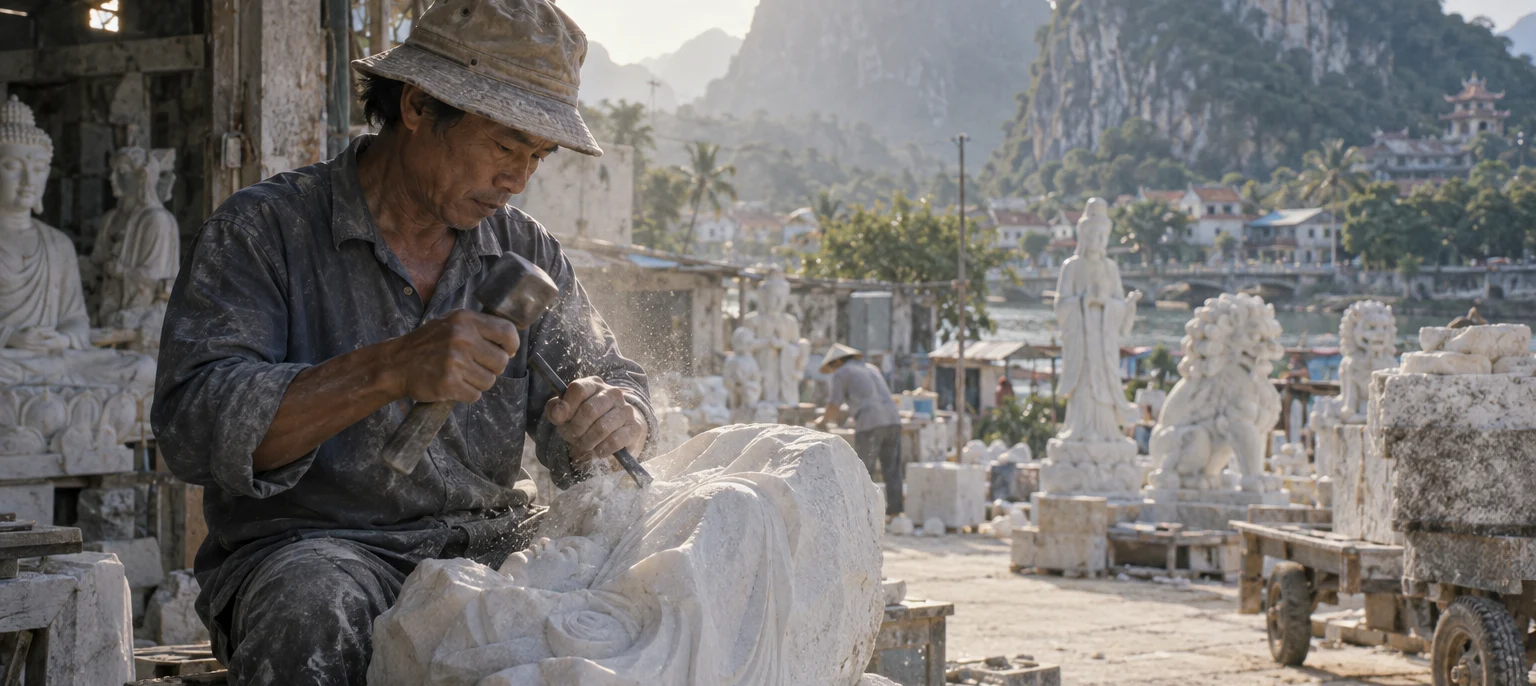
The Marble Mountains are five limestone and marble outcrops rising from the sand south of Đà Nẵng, full of caves and pagodas. Carvers settled at their foot several centuries ago, drawn by the stone, and made mortars, grinding stones, steles and tomb pieces as well as figures for the temples. Over time the village became the main centre of stone carving in the centre of Vietnam. Some families trace their trade back to carvers who came south from the stone country of Thanh Hóa, and the skills passed from father to son.
Quarrying the mountains themselves is now forbidden, and the stone comes from other provinces and abroad. The street has also changed: it is lined with large showrooms selling to tourists and to hotel and garden buyers, and much of the rough shaping is now done with power tools. Behind the showrooms, though, workshops still carve and finish by hand, and the best carvers are known for figures, lions and small vessels where the final surface is entirely chisel, rasp and polishing stone.
To tell good work, look at the parts that are hard to reach: the inside of a curled hand, the space between a lion’s teeth, the underside of a fold of cloth. Hand-finished stone has crisp edges there and an even polish. Machine-roughed pieces tend to be soft and slightly blurred in those places. Ask what the stone is and where it came from; good carvers will tell you.
02 — The technique
What makes Non Nước marble carving
Power tools now do some of the heavy work, but the finish that matters is still made by hand.
I
Choosing the block
Carvers read a block for colour and veining before marking it out, so a flaw does not run through a face or a hand.
II
Roughing out
The figure is blocked in from the stone, by hammer and point or, increasingly, by cutting disc.
III
Chisel and rasp
Detail is cut with fine chisels and refined with rasps and files, the stage that separates a carver from a factory.
IV
Polished by stone
Surfaces are rubbed with progressively finer abrasives and water until the marble takes its sheen.
Words you will meet
Đá cẩm thạch
Marble.
Ngũ Hành Sơn
The Marble Mountains, literally the Five Elements Mountains.
Đá mỹ nghệ
Fine stone carving, as opposed to building stone.
Đục
Chisel; also the verb to chisel.
03 — Visiting
Visiting Non Nước
Non Nước is easy to reach from Đà Nẵng or Hội An and is best combined with a morning climb in the Marble Mountains. The showrooms on the main road are not where the carving happens; ask to see a workshop behind, and do not feel obliged to buy. LangSoul does not run trips here, but readers can write to us for an introduction.
- From Đà Nẵng / Hội An
- About 20 minutes / 25 minutes by car
- Best season
- February to August, before the autumn rains
- Look for
- Crisp detail in hard-to-reach places and an even hand polish
The other villages
The full atlas






