Craft village
Phước Kiều
- Craft
- Bronze gongsĐúc đồng
- Where
- Điện Bàn, Quảng Nam
- Practised since
- c. 400 yearsGongs tuned by ear
- Material
- BronzeSand-cast, hand-tuned
- On LangSoul
- RecordedNot yet carried
01 — The story
One lane, four centuries of bronze
Phước Kiều lies inland from Hội An, in Điện Bàn. Bronze casters settled here around four hundred years ago, and for much of that time they made bells, gongs and ritual objects for the temples and pagodas of the centre, along with household brass. Their most famous customers were the peoples of the Central Highlands, whose gong ensembles are central to their ceremonies, and who came down from the mountains to buy or had gongs carried up to them.
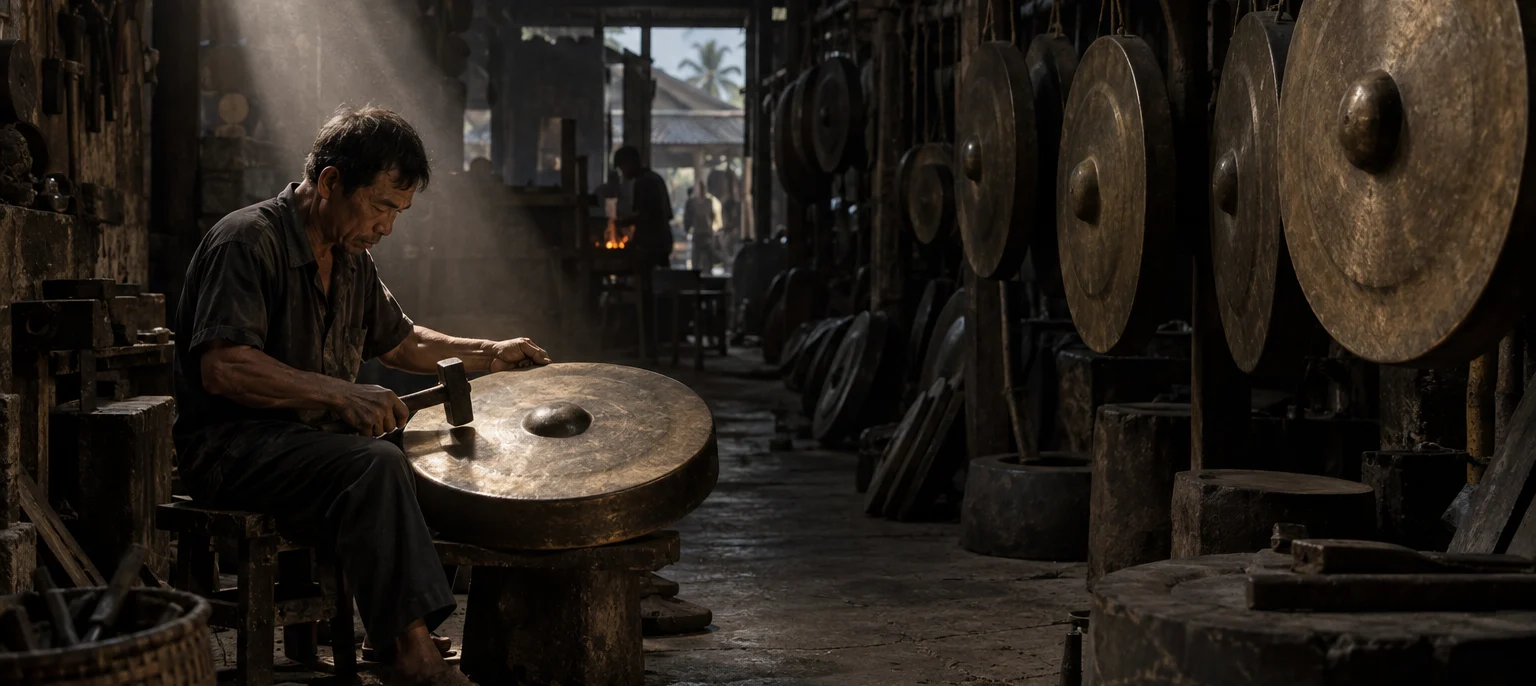
The village is still a working foundry street. Several households cast, though the number is smaller than it was, and much of the trade is in gongs, bells and temple pieces rather than domestic ware. Gong-making in particular depends on a few experienced tuners whose ears cannot be replaced by a machine. Highland communities still bring gongs to be retuned, and you may hear them being tested. Casting is done in the open yard in small batches, and a pour is over in minutes after hours of preparation of the mould and the metal.
A good Phước Kiều gong has an even, clean casting with no pitting, a raised boss that is well centred, and a long sustained note. In a set, each gong should sit clearly in relation to the others. Hold a gong by its cord and strike it gently; it should ring evenly without buzzing or a dead spot.
02 — The technique
What makes Phước Kiều bronze gongs
Casting gives a gong its shape; tuning by ear gives it its voice.
I
The alloy
Copper is melted with tin and other metals in proportions each family guards, which decide the colour and tone of the bronze.
II
Sand moulds
Molten bronze is poured into moulds of packed sand and clay shaped around a pattern, one casting at a time.
III
Cleaning and turning
The rough casting is filed, scraped and polished until the surface is smooth and the thickness even.
IV
Tuned by ear
The tuner hammers the gong in small, precise blows, listening after each, until it reaches the note it needs.
Words you will meet
Đúc đồng
Bronze casting.
Cồng chiêng
Gongs; cồng have a raised boss, chiêng are often flat.
Khuôn
Mould.
Chuông
Bell.
03 — Visiting
Visiting Phước Kiều
Phước Kiều is an easy half day from Hội An, and the casting is most likely in the cooler morning hours. Foundries are hot and dangerous, so watch from where you are shown and keep children close. LangSoul does not run trips here, but readers can write to us for an introduction.
- From Hội An / Đà Nẵng
- About 25 minutes / 40 minutes by car
- Best season
- February to August, outside the flood months
- Look for
- A clean casting and a long, even note without buzzing
The other villages
The full atlas






