Craft village
Tân Châu
- Craft
- Black silk (lãnh Mỹ A)Lụa
- Where
- An Giang
- Practised since
- c. 100 yearsBlack silk of the Mekong
- Material
- Silk, mặc nưa fruitDyed a hundred times
- On LangSoul
- RecordedNot yet carried
01 — The story
Black as wet stone, cool as water
Tân Châu stands on the Tiền river close to the Cambodian border, and in the early twentieth century it was one of the great silk towns of the Mekong. Mulberry grew on the alluvial banks, families raised silkworms and wove at home, and the town’s plain black silk was worn across the south. The finest grade took the name Mỹ A, and lãnh Mỹ A became a byword for quality: a fabric for the áo bà ba and the trousers of women who could afford to be well dressed.
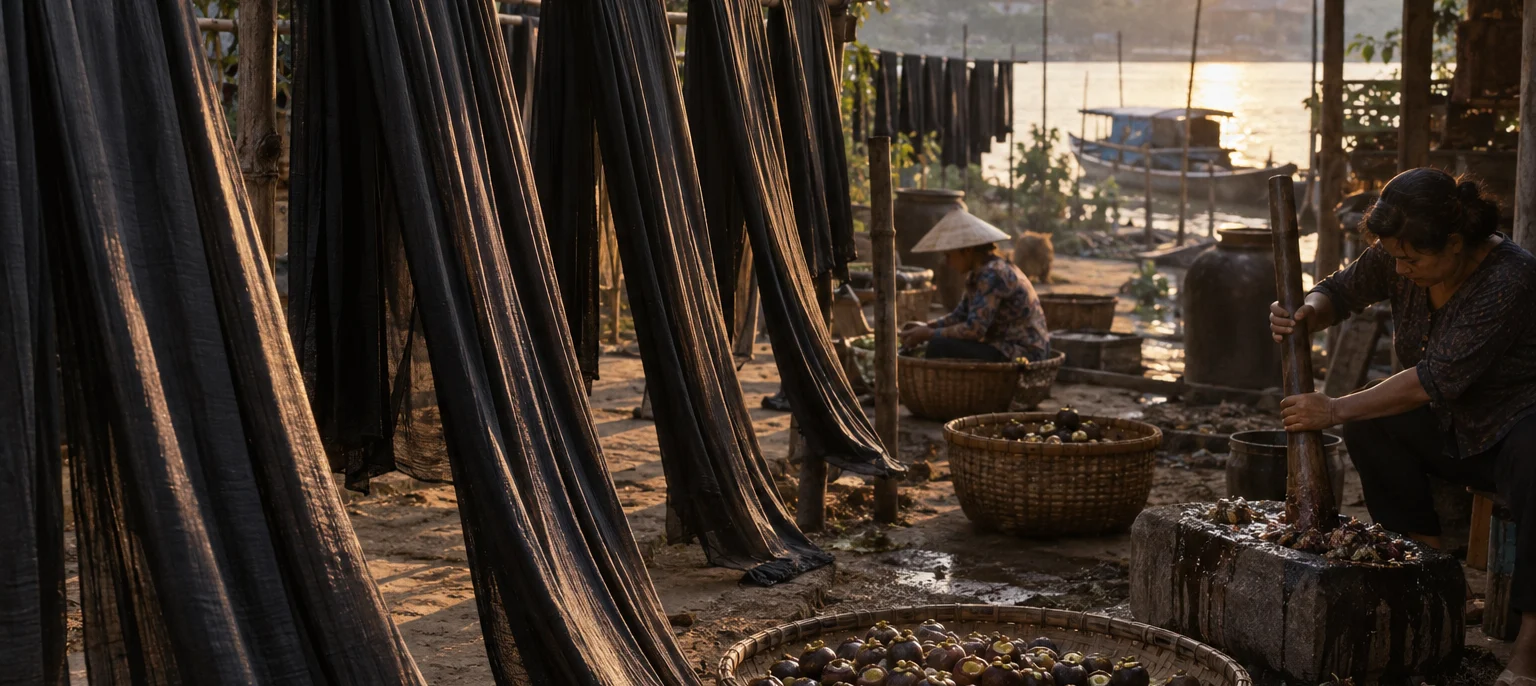
The trade shrank sharply in the second half of the century, as cheaper fabrics arrived and the mặc nưa dye became slow work few young people wanted. Today only a small number of families weave and dye in the old way, alongside a larger output of machine-made cloth sold under the same name. Where it survives, the process takes weeks: the fruit is crushed, the woven silk is soaked in its juice and spread in the sun, again and again, the colour darkening with each pass.
Good lãnh Mỹ A is deeply black with a soft shine, not a hard gloss. It drapes and falls heavily, feels cool, and does not rub off on the hand. Look closely and you may see a subtle woven pattern in the cloth, visible only when the light catches it. The colour should be even across the length; patchy or brownish areas suggest a short dyeing. Real Mỹ A silk is said to grow softer and more lustrous with washing.
02 — The technique
What makes Tân Châu black silk
The cloth is woven first and dyed afterwards, and the dyeing is what takes the time.
I
Woven in the house
Raw silk is woven into plain or subtly patterned lengths on looms in family workshops.
II
Soaked in mặc nưa
The fruit of the mặc nưa tree is crushed and the cloth is soaked in its juice, which works as both dye and mordant.
III
Dried in the sun
After each soaking the silk is spread on the grass or on poles to dry, and the cycle is repeated many dozens of times.
IV
Finished by hand
The dyed cloth is washed and worked until it is supple, the black settled into the fibre.
Words you will meet
Lãnh Mỹ A
The finest black silk of Tân Châu, named for its grade.
Mặc nưa
Diospyros mollis, the ebony-family tree whose fruit gives the black dye.
Lụa
Silk cloth.
Áo bà ba
The loose shirt of southern Vietnam, traditionally made in black silk.
03 — Visiting
Visiting Tân Châu
Tân Châu is a long day from Hồ Chí Minh City, and better reached from Cần Thơ or Châu Đốc with a night in the area. The dyeing is outdoors and depends on the sun, so dry-season mornings are the best chance of seeing silk laid out; ask in the market for the families who still use mặc nưa. Write to us if you would like an introduction.
- From Cần Thơ
- About three hours by car
- Best season
- December to April, when the sun dries the dye
- Look for
- An even, soft black that does not rub off
The other villages
The full atlas






