Craft village
Thanh Hà
- Craft
- TerracottaGốm
- Where
- Hội An, Quảng Nam
- Practised since
- c. 16th centuryTiles for Hội An
- Material
- River clayKick-wheel, brick kilns
- On LangSoul
- RecordedNot yet carried
01 — The story
The roof tiles of Hội An
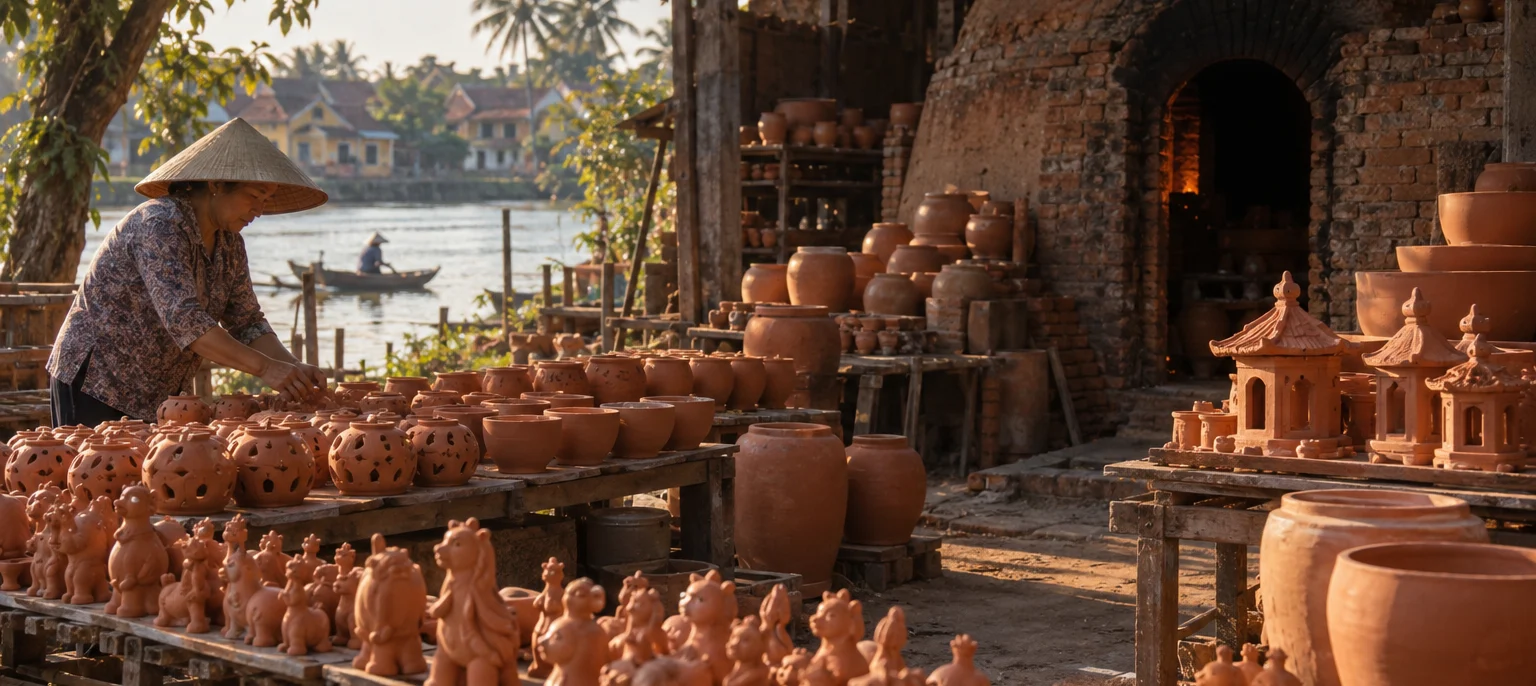
Thanh Hà sits on the Thu Bồn river a few kilometres upstream from Hội An. Potters settled here in the sixteenth century, when Hội An was a busy port trading with Japan, China and beyond, and the town needed bricks, roof tiles and everyday jars in quantity. The clay came from the riverbanks, and boats took the finished work down to the town and along the coast. The curved, interlocking tiles that cover the old merchant houses were made here.
As the port declined and industrial brick and tile arrived, most kilns closed. The village survives today partly on the repair of Hội An’s heritage buildings, which still need its tiles, and partly on visitors. A small number of families still throw on kick-wheels, and you will see pots, vases, figures and clay whistles in the shape of animals made for tourists alongside the more serious work. A terracotta park in the village shows the history of the craft. Watching a thrower at the wheel for ten minutes tells you more about the craft than the displays do.
Good Thanh Hà terracotta has an even orange-red colour, sometimes with darker patches where it sat close to the fire. The walls of thrown pieces should be consistent, and the base cleanly cut. Tap a tile or pot: a clear ring means a good firing, a dull sound means it was underfired or is cracked.
02 — The technique
What makes Thanh Hà terracotta
The craft depends on river clay, a foot-driven wheel and a kiln built of the village's own bricks.
I
River clay
Clay from the Thu Bồn banks is mixed, soaked and trodden by foot until it is smooth and free of stones.
II
Kick-wheel
The potter turns the wheel with a foot or with a helper's push, shaping the piece by hand as it spins.
III
Moulded tiles
Roof tiles are pressed in moulds and curved over forms, so they lock together on the roof.
IV
Brick kilns
Work is dried in the shade and then fired in brick kilns, traditionally with wood, for a day or more.
Words you will meet
Gốm đất nung
Terracotta, fired unglazed clay.
Ngói âm dương
Yin-yang roof tiles, laid alternately face up and face down.
Bàn xoay
Potter's wheel.
Lò nung
Firing kiln.
03 — Visiting
Visiting Thanh Hà
Thanh Hà is a short bicycle ride from Hội An and gets busy with tour groups in the middle of the day, so go early. Some households charge a small entry fee or expect a purchase; the clay whistles are inexpensive and a fair way to say thank you. LangSoul does not run trips here, but readers can write to us for an introduction.
- From Hội An
- About 10 minutes by bicycle or car, 3 km
- Best season
- February to August; avoid the October–November floods
- Look for
- Even orange-red colour and a clear ring when tapped
The other villages
The full atlas






