Craft village
Thổ Hà
- Craft
- Pottery & rice paperGốm, bánh đa
- Where
- Việt Yên, Bắc Giang
- Practised since
- c. 14th centuryPottery then rice paper
- Material
- Rice flour, river waterDried on bamboo racks
- On LangSoul
- RecordedNot yet carried
01 — The story
Behind the gate on the Cầu river
Thổ Hà sits on a bend of the Cầu river, facing Bắc Ninh across the water. For centuries it was a potters’ village, making stoneware jars, urns and vats that went down the river by boat to the markets of the delta. Its prosperity shows in its buildings: a carved seventeenth-century communal house, an old village gate, brick lanes and houses close-packed inside the river bend. The pottery of Thổ Hà was mostly plain stoneware, made for storage and burial rather than for display.
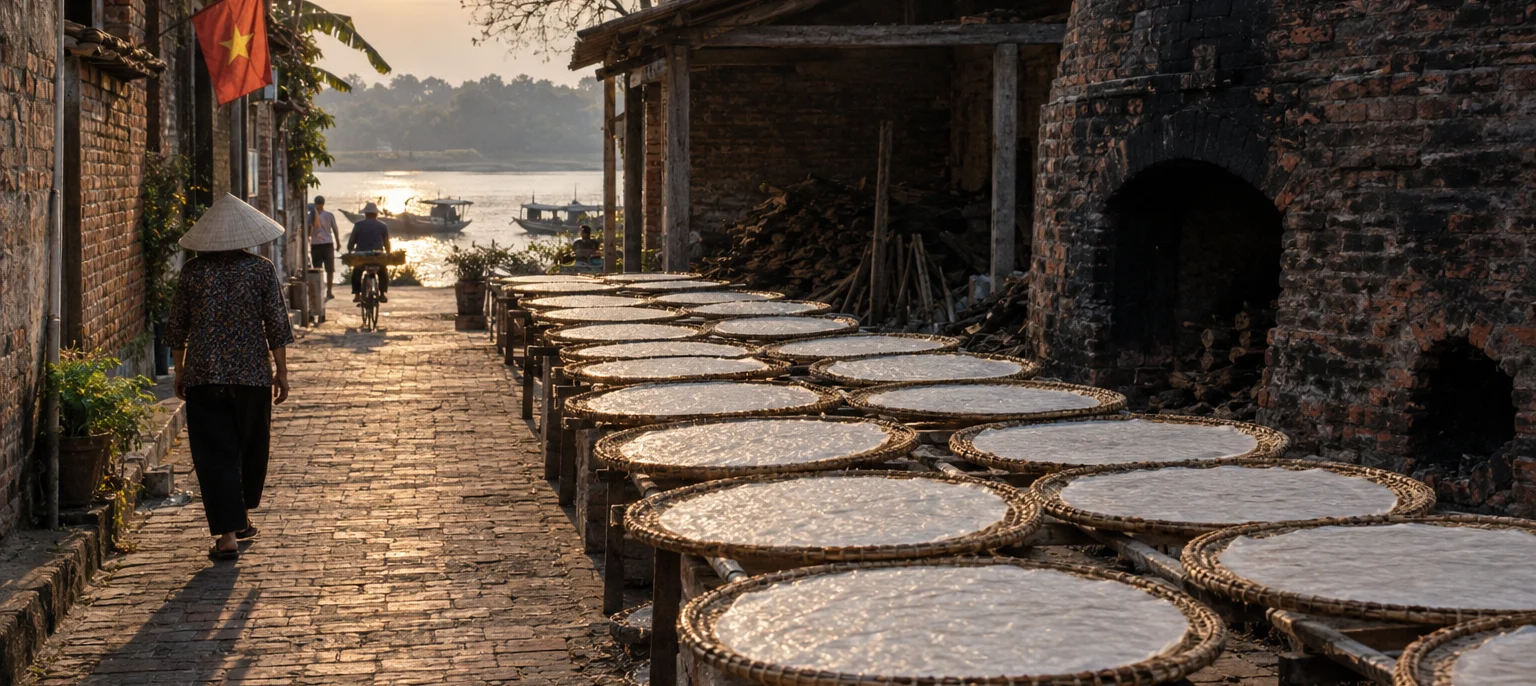
During the twentieth century demand for the old stoneware fell, and by the 1990s the kilns had largely gone cold. The village turned to rice: rice paper for spring rolls, rice crackers, and rice wine made from the same grain. In good weather the open spaces and roadsides are lined with bamboo racks of drying rice paper. A few people have tried to revive pottery in small ways, and broken shards still turn up in walls and paths. Rice-paper making begins well before dawn, and on a fine day a single family may turn out thousands of sheets.
Good rice paper from Thổ Hà is thin, evenly round and slightly translucent, with the fine cross-hatched print of the bamboo rack on its surface. It should be flexible once moistened and crisp when fried, without tearing. The village’s older stoneware, when you find it, is heavy, brown and unglazed or thinly glazed, much like that of other river kilns. Rice wine from the village is clear and strong, distilled from glutinous rice, and is sold from the house.
02 — The technique
What makes Thổ Hà rice paper
The work is fast, hot and repetitive, and the weather decides the day.
I
Soaked and ground
Rice is soaked and ground with water to a smooth, thin batter, which rests before it is used.
II
Steamed on cloth
A ladle of batter is spread over a cloth stretched across a pot of boiling water, and steamed for a few seconds.
III
Lifted with bamboo
The sheet is lifted off with a thin bamboo stick and laid on a woven bamboo rack.
IV
Sun-dried
The racks are set in the sun for several hours. The rack leaves its pattern on the sheet.
Words you will meet
Bánh đa nem
Rice paper for spring rolls.
Bánh đa
Rice cracker, often with sesame.
Gốm sành
Stoneware, the village's old trade.
Đình
The communal house of a village.
03 — Visiting
Visiting Thổ Hà
Come on a dry, sunny morning to see rice paper being made and racks filling the open ground. The communal house and the old gate are the heart of the village; dress modestly and remove shoes where asked. Write to us if you would like an introduction.
- From Hà Nội
- About an hour and a half by car
- Best season
- Dry months, October to April
- Look for
- The village gate, the communal house and racks of drying rice paper
The other villages
The full atlas






