Craft village
Tương Bình Hiệp
- Craft
- Southern lacquerSơn mài
- Where
- Thủ Dầu Một, Bình Dương
- Practised since
- c. 300 yearsLacquer of the south
- Material
- Natural lacquerMother-of-pearl inlay
- On LangSoul
- RecordedNot yet carried
01 — The story
Northern lacquer, southern light
Tương Bình Hiệp lies on the edge of Thủ Dầu Một, in country that was rubber and orchard long before it was industrial estate. Lacquerers came here from the north some three centuries ago, bringing the resin, the sanding stones and the patience the work demands. Over generations the palette warmed. Reds grew deeper, gold leaf more generous, and the shell of the river and the sea, cut into petals, birds and bamboo leaves, became the mark of southern work.
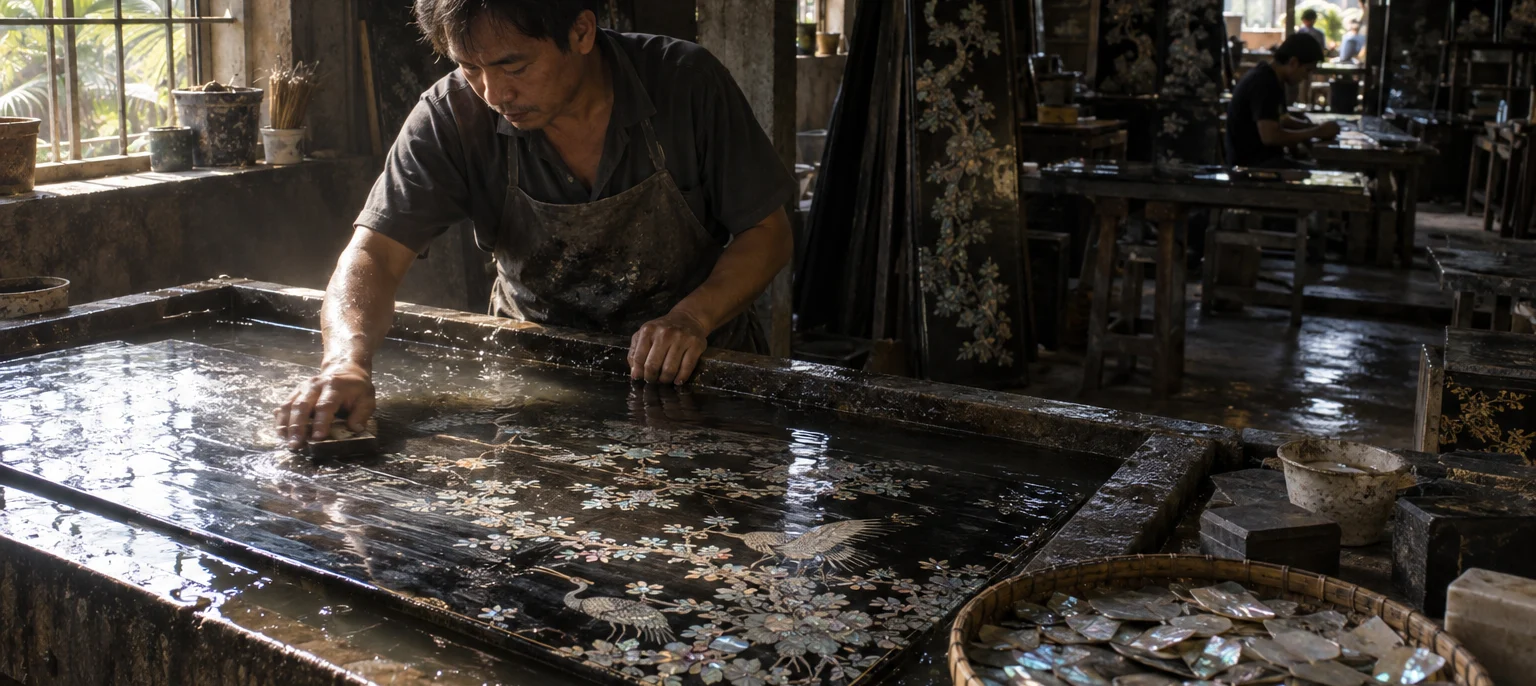
The village still lacquers, though the trade has changed around it. Much of what leaves Bình Dương now is made quickly for export, with synthetic coatings that dry in hours. A smaller number of workshops keep to natural lacquer, building a panel or a box in many thin coats over weeks, each one dried in a damp room and rubbed back before the next. Walk past the open fronts and you will see boards stacked to cure, and the grey slurry of the sanding trough on the floor.
Good work shows itself in the hand and in the light. A natural lacquer surface is deep rather than shiny; you seem to look into it, not at it. Shell inlay should sit perfectly flush, with no ridge under the finger, and its edges should be cleanly cut. Turn a piece over: the back of a serious panel is lacquered too, so that the board does not warp. Colours laid under the final coats and polished up through them have a softness that paint on top never has.
02 — The technique
What makes Tương Bình Hiệp lacquer
The depth of a southern lacquer comes from layering and from sanding away almost as much as is laid on.
I
Many thin coats
The board is primed and then built up in layers of natural resin, each dried slowly in a humid room before the next goes on.
II
Shell set into the lacquer
Mother-of-pearl and eggshell are cut, laid into the wet coats and buried under further layers, not glued onto the surface.
III
Sanded back
Each layer is rubbed down with stone and water so the colours and inlay below come up through the surface.
IV
Polished by hand
The last polish is done with fine powder and the palm of the hand until the surface glows rather than glares.
Words you will meet
Sơn mài
Literally 'lacquer-sanded': lacquer built up in layers and polished back to reveal the image.
Sơn ta
Natural Vietnamese lacquer, the resin of the lacquer tree.
Cẩn ốc
Mother-of-pearl inlay, cut from river and sea shell.
Vỏ trứng
Eggshell, crushed and set into lacquer for pale tones.
03 — Visiting
Visiting Tương Bình Hiệp
The village is an easy morning from Hồ Chí Minh City, and several workshops have showrooms at the front where you can see work in progress behind. Go on a weekday, ask before photographing the sanding rooms, and expect much of what is on show to be made for export. Write to us if you would like an introduction.
- From Hồ Chí Minh City
- About an hour by car
- Best season
- December to April, the dry season
- Look for
- Shell inlay that sits flush under the finger
The other villages
The full atlas






