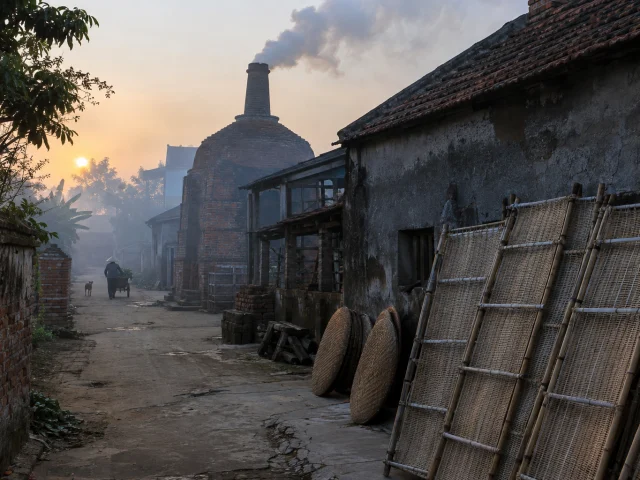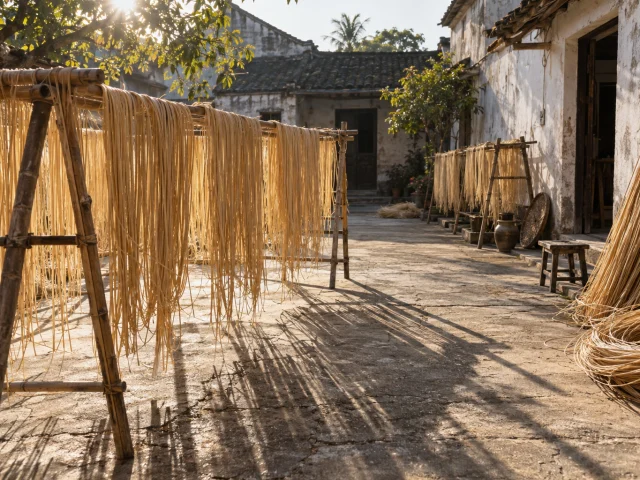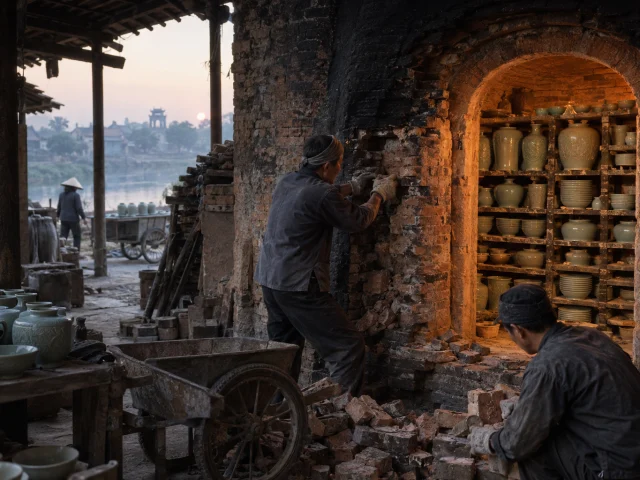
The lane into Hạ Thái smells of resin before you can see a workshop. It is a sweet, sharp smell, a little like cut grass left in the sun, and it comes from the cabinets: tall wooden boxes in every courtyard, their doors shut, a wet cloth hung inside. Lacquer does not dry. It cures, slowly, in damp air, and the cabinet is the village’s way of making the rainy season last all year.
We came in March, the dry month, because that is when Nguyễn Văn Thái starts a panel. “The first coats need to go on slow,” he said, tapping a raw board the colour of bread. “If they go on fast, the whole thing is in a hurry for the rest of its life.”
Thái is the third generation of his family at the bench in Hạ Thái, the lacquer village south of Hà Nội. The village has made sơn mài, polished lacquer, for some three centuries, and the resin still comes from the same place: sơn ta, tapped from the lacquer tree in the hills of Phú Thọ, filtered and left to age before it is used. It is a living material. It darkens for decades, and it will not be hurried by heat.
I · The board
Jackfruit wood, dried for a year under the eaves. Thái wraps it in cotton cloth, soaks the cloth in raw lacquer mixed with river clay, and leaves it in the cabinet for a week. Then he sands it back. Then he does it again. The cloth and clay are the panel’s skeleton; without them, the wood would move with the seasons and crack the surface decades from now.
Nothing about this first fortnight looks like art. The board goes into the cabinet grey and comes out grey. Thái’s father did this part for forty years, he says, and never once laid a picture on top of it.
II · The moon
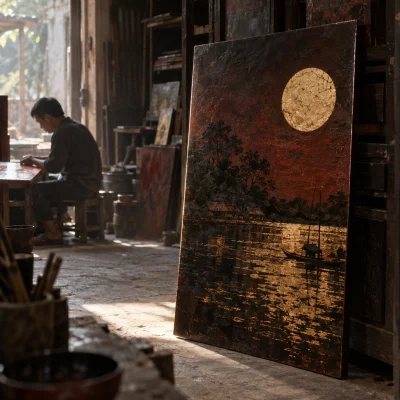
Lacquer has no white. It can be black, red, brown, and with gold or silver leaf it can be light itself, but it cannot be white — and so the village learned, perhaps three hundred years ago, to press duck eggshell into the wet surface. Đỗ Thị Hương, Thái’s wife, sorts the shell by its curve on a tray in the window. The flatter pieces go in the middle of the moon, the curved ones at the rim, so the cracks between them radiate.
It took her three mornings. Then Thái laid gold leaf beneath where the water would be, and buried the whole picture under three more coats of lacquer, until there was nothing to see at all.
“You have to be willing to lose the picture to get it back. That is the whole craft.”
The eggshell is Đỗ Thị Hương’s eggshell inlay, and it is the reason the two of them work as a pair. Her small square seal sits beside his on the reverse of every work they make together. The same patience goes into her own pieces — the tall eggshell vase, for instance, which carries a full surface of shell laid fragment by fragment over turned jackfruit wood.
III · The layers
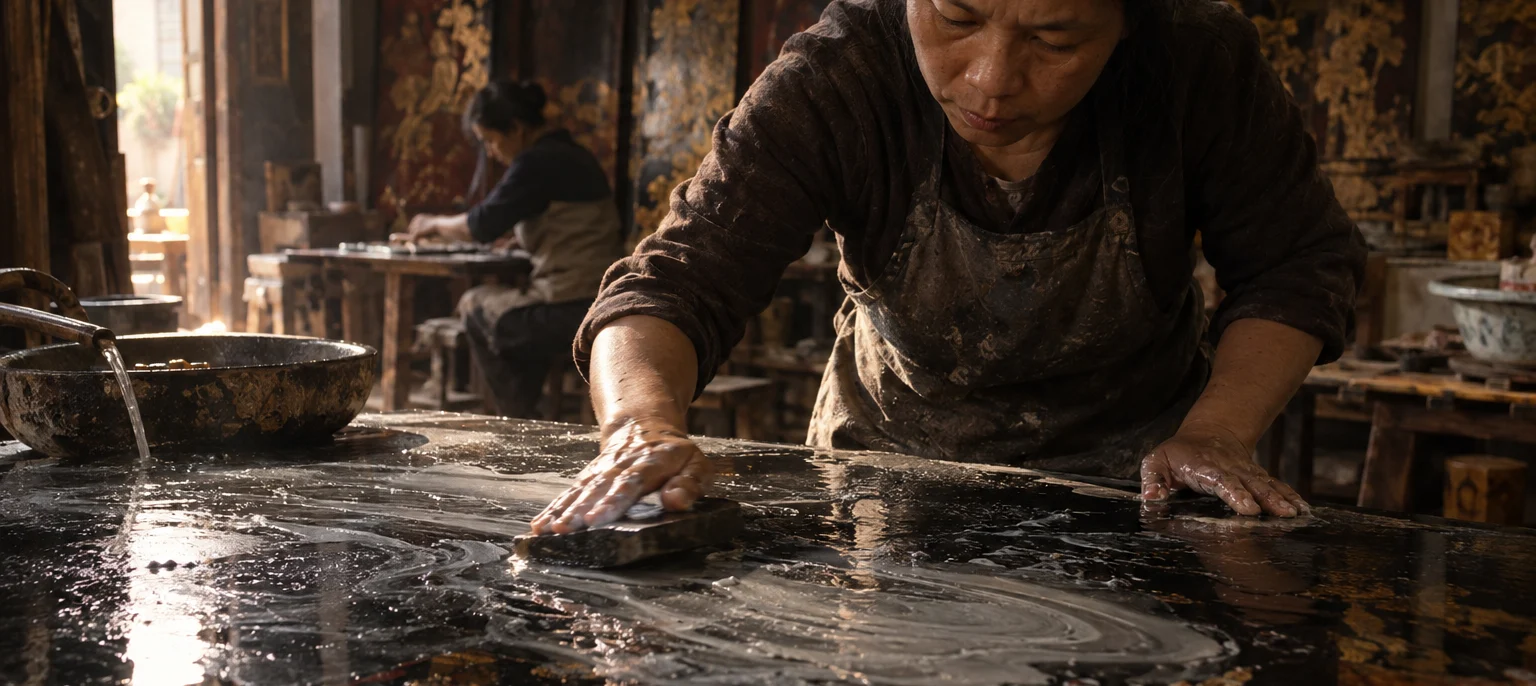
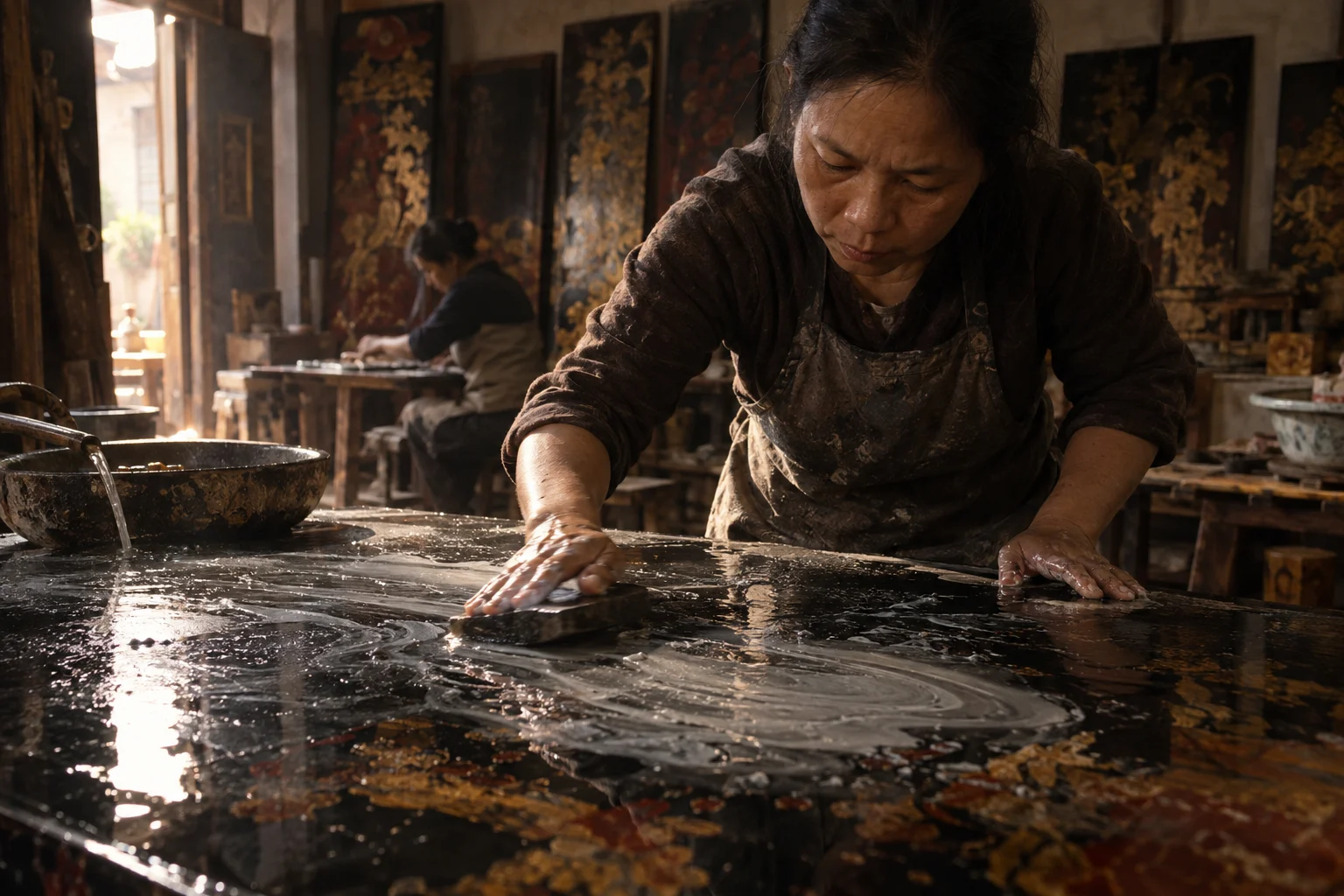
Twelve coats, each a week in the cabinet, each sanded back under a thin stream of water with a piece of charcoal and then a stone. The water keeps the dust down and shows Thái where the surface is still high. By the sixth coat the board is black and deep as a well; by the ninth you can see a faint pale disc under the surface, like the moon through cloud.
We asked how he knows when a coat is ready. He pressed a thumbnail into the edge of the board and showed us the mark it did not leave.
This is also why nobody in the village trusts a panel started in the rains. In the heat of summer the cabinets are too warm and the coats cure too quickly from the top, so the surface skins over before the layer beneath has settled. A board made that way may look the same on the day it leaves the workshop. It does not polish to the same depth, and the difference shows within a few years. A slow start in the dry months is the only route Thái will take.
IV · The polish
The last week is the one visitors photograph: Thái with the palm of his hand flat on the board, polishing in circles with a little powdered charcoal and his own warmth. This is where the moon comes back — not all at once, but where he presses hardest, and where the gold under the water surfaces as if the light were coming from behind the panel.
He stopped on the fourteenth of June. We asked how he knew it was finished. “It stopped drinking the light,” he said, and put his seal into the last soft coat on the reverse.
V · How to tell a hand-polished lacquer panel
Much of what is sold as Vietnamese lacquer abroad is made with synthetic or cashew-based finishes, sprayed or brushed on in a few coats. It can be handsome. It is not the same thing, and a few signs separate the two.
- Depth. In true sơn mài the picture sits inside the surface rather than on it. Tilt the panel and the gold and shell seem to move a little beneath the gloss, because they are under several cured layers.
- Eggshell cracks. Hand-laid shell shows a fine, irregular network of cracks between fragments, often radiating from the centre of a shape. Printed or moulded imitations repeat.
- The edges and the reverse. A panel built on cloth and clay over jackfruit wood is finished on every face, and the reverse carries the maker’s seal in the last coat.
- Weight and sound. Moon over Hạ Thái measures 80 × 60 cm and weighs 3.4 kg; a panel of that size made the slow way is heavy for its thickness, and knocks with a dull, solid note.
Thái’s work is collected under Nguyễn Văn Thái, lacquer master, where you can see the trays and bowls that share this method with fewer layers.
VI · Caring for lacquer at home
Natural lacquer is forgiving, but it has preferences. Keep it out of direct sun, which will slowly bleach the colour. Dust it dry, with a soft cloth; never use a spray polish. In a heated room in winter, a bowl of water nearby helps the resin, which was cured in damp air and prefers it. Once a year, a little camellia oil on the palm, rubbed in lightly, is all the polish it needs. Our shipping and care notes for each craft give the full list, and every work leaves the studio with its own care sheet.
VII · The next board
The panel is called Moon over Hạ Thái. It is on LangSoul now, waiting for a room. Thái started another board the week we left. The weather, he said, was right.
If you would like a panel made to the width of a particular wall, it can be done — but it will be started in the dry months, and it will take as long as it takes. Thái accepts a small number of lacquer commissions each year.