There is a calendar in the delta that has nothing to do with the one on the wall. It is made of weather and of what the weather does to clay, cane, resin and thread, and every village we work with keeps a different page of it.
We spent a year visiting the eight of them in turn, and this letter is what we learned: when to go, what will be happening in the courtyards, and why a work that arrives in March could not have been made in July.
The eight villages sit within an hour or so of Hà Nội. Bát Tràng is on the bank of the Red River to the east; Phú Vinh is to the west, where the flat land begins to lift towards the hills; Hạ Thái and Quất Động are a few lanes apart in Thường Tín, to the south; Đại Bái and Đồng Kỵ are across the river in Bắc Ninh; Vạn Phúc and Định Công have been swallowed by the city itself. They share one sky. What differs is what each material asks of it.
I · The dry months
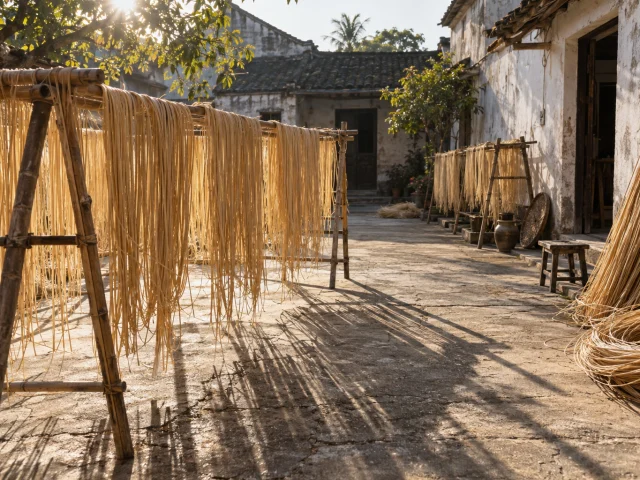
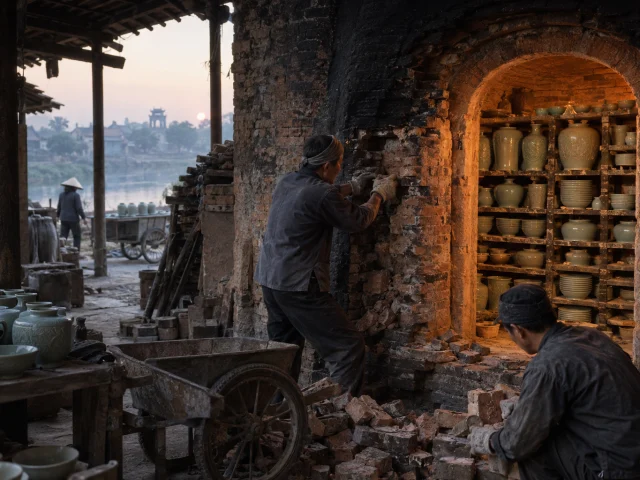
From November to April the air is cool and the sky is grey, and this is when the delta makes things. Lacquer cures evenly in the damp cool of a Hạ Thái cabinet; a panel started now will polish true. Phú Vinh’s cane dries on the racks without mildew. The Bát Tràng kilns fire week after week, and the village is busiest in the run-up to Tết, when every house in the north needs a new set of bowls.
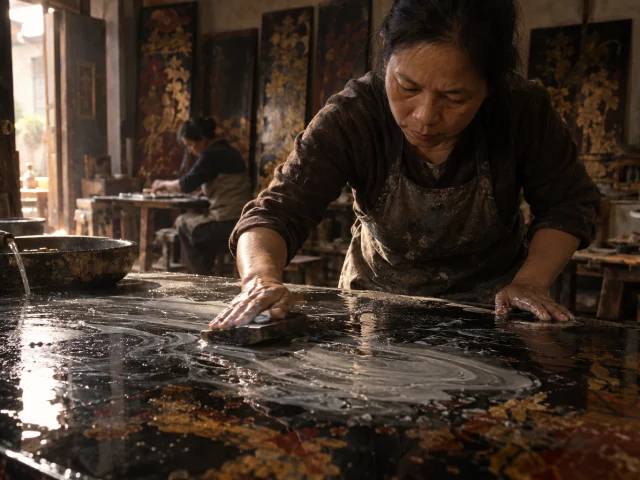
Lacquer is the clearest case. The natural resin used in the lacquer village of Hạ Thái — sơn ta, tapped from trees in the hills of Phú Thọ — does not dry in heat. It cures in humidity, slowly, inside the closed wooden cabinets every courtyard keeps, and each coat needs about a week before it can be sanded back. In the cool months that cure is even from edge to centre. We followed one board through all of it in twelve layers, three months, and the season was half the story.
In Đồng Kỵ the timber yards are stacked with ironwood and rosewood that has been drying under cover for two or three years. The carvers cut their joints in the dry months, when the wood is at its steadiest, and the oil-and-wax finish goes on in air that will not swell the grain overnight.
Quất Động’s embroiderers begin their panels in the week of the new year, because the mornings are long and the light is flat. Hoa’s lotus pond was begun then and finished with the first rains.
II · The rains
From May the heat comes, and with it the rain. Lacquer started now cures too fast and never polishes like a dry-season board — Thái will not begin a panel after April. The kilns slow; the clay will not dry on the shelves. But the foundries of Đại Bái pour on, before dawn, when the air is cool enough for the metal, and the looms of Vạn Phúc run all year behind closed shutters.
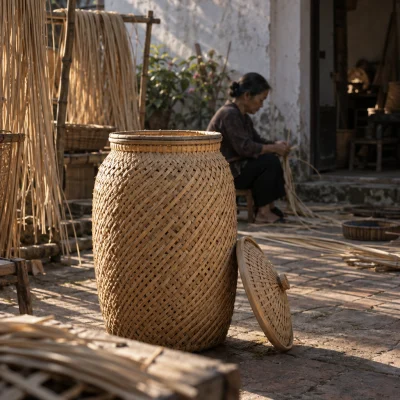
The wet months are not idle months. In the weaving village of Phú Vinh the work moves from the courtyards into the doorways, where the light is good until late morning, and the cane split and dried in the winter is woven into the pieces that need the most patience. Trần Thị Mai’s lidded vessel in the rain pattern was woven in April and May, as the weather turned, from strands that had dried in the sun weeks before.
In Định Công the silversmiths hardly notice the season at all. Silver is drawn into thread and twisted into filigree at a bench indoors, and a room off the main road is the same room in July as in January.
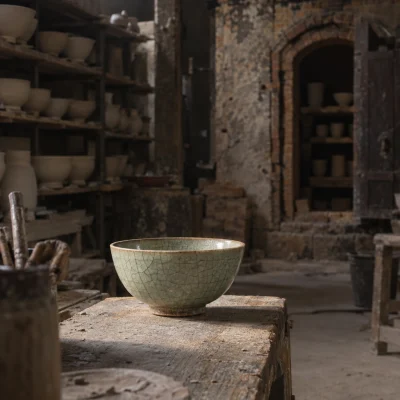
Bát Tràng never stops entirely. A potter who knows his kiln will fire through the summer when the clay allows, and Phạm Văn Đức’s celadon tea bowls with their crackle glaze came out of a firing in May and June. But the shelves of drying pots are shorter, and a wet week can hold a load back until the air clears.
III · The turn
September is the month the delta waits for. The rains thin, the cane is cut and set to dry, the first boards are sealed. By the time the letter you are reading was written, the courtyards had filled again.
October is when the year begins again in earnest. In Hạ Thái the first coats of cloth and river clay go onto new boards. In Phú Vinh the racks go back out into the lanes. In Đại Bái the foundry pours more often as the mornings cool, and the moulds built in the summer can finally dry slowly in the yard, as they must.
IV · When to visit the villages
If you are travelling to northern Vietnam and want to see the work being made rather than simply sold, the season matters more than the day of the week.
- Hạ Thái and Quất Động: October to April. Lacquer is curing in every courtyard and the embroidery frames are full. The two villages are close enough to see in a single day.
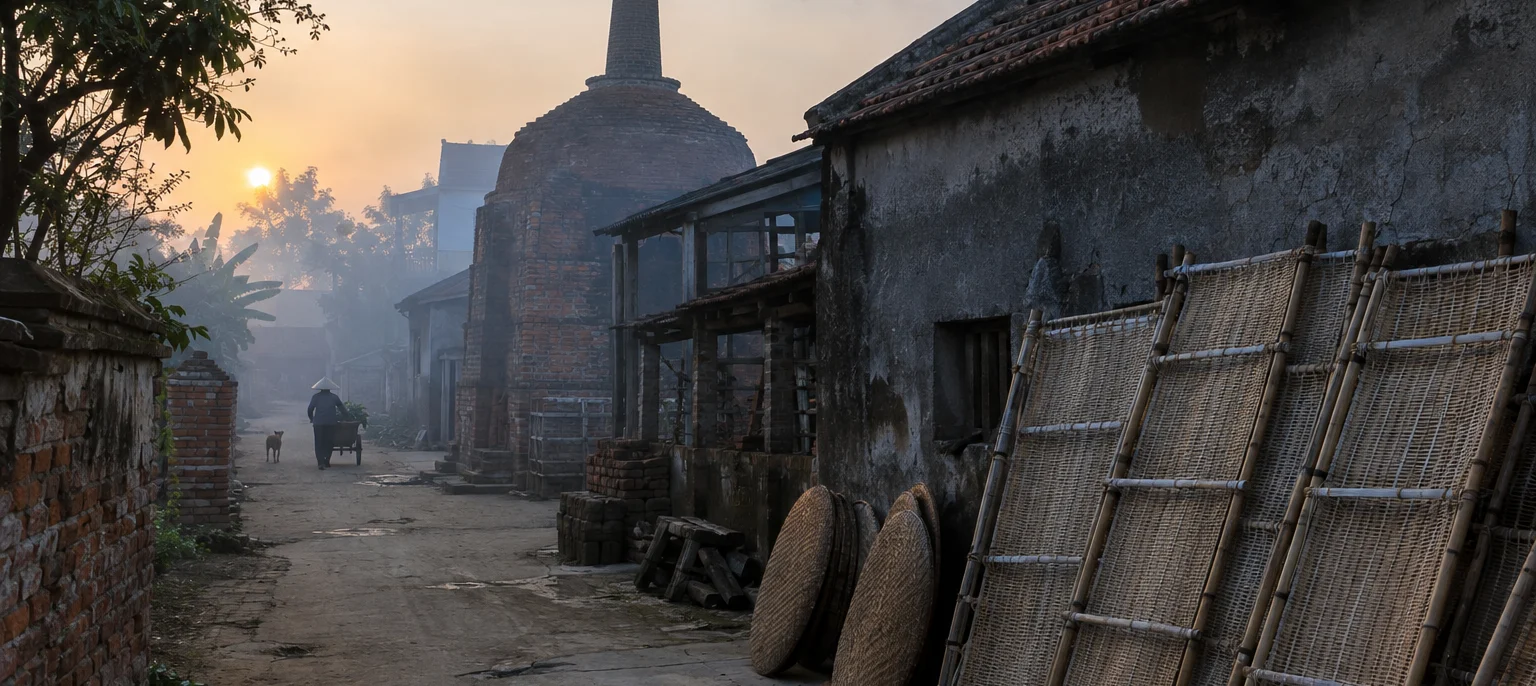
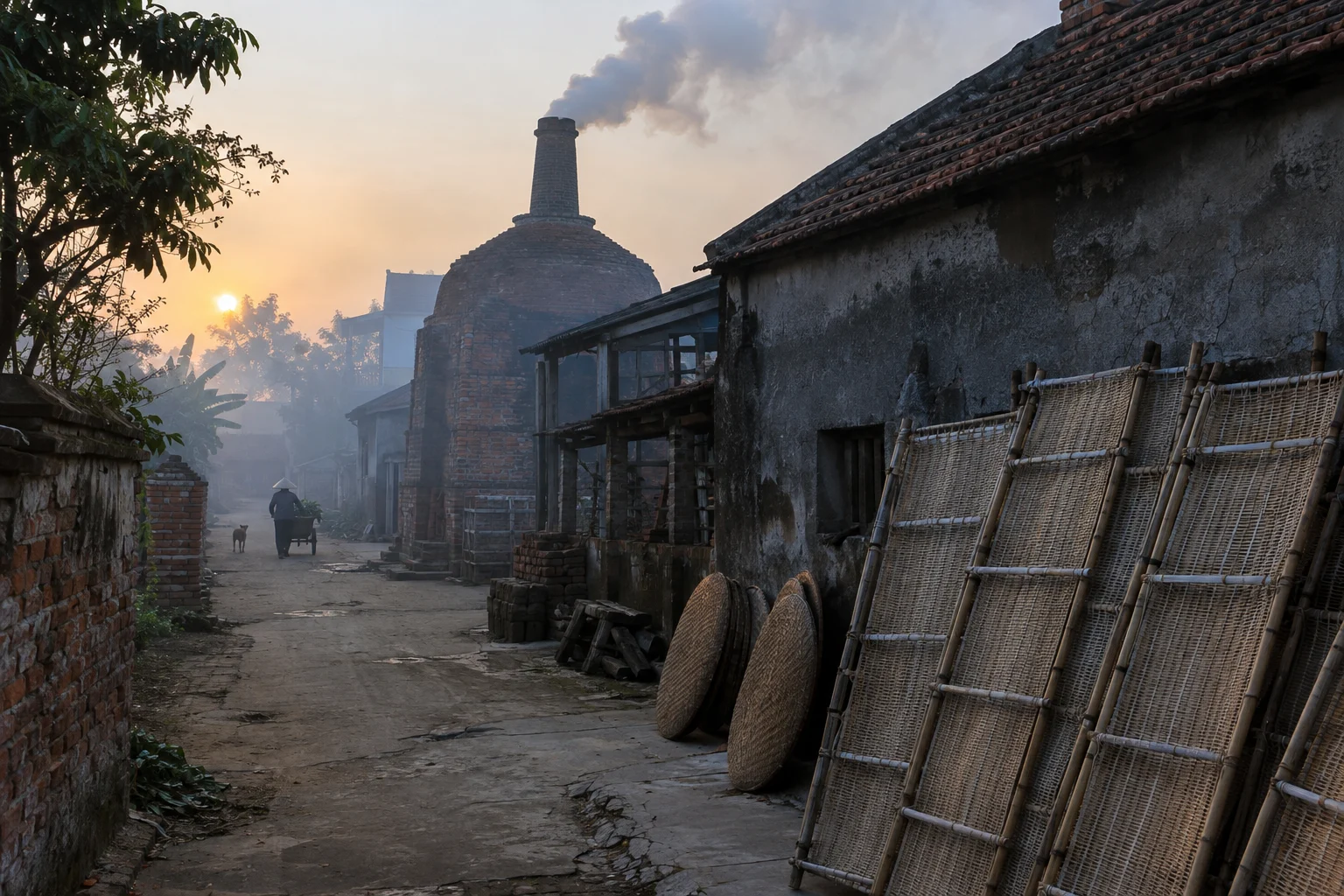
- Phú Vinh: November to April, when the cane is drying on the racks and the lanes are pale with it.
- Bát Tràng, the ceramics village: all year, but the dry months for a kiln opening at dawn.
- Đại Bái, the bronze-casting village: October to March, when the foundry pours most often.
- Vạn Phúc and Định Công: all year. Both are inside the city and suit an afternoon.
- Đồng Kỵ: October to April, when the carving workshops are at full pace.
Avoid the week of Tết itself unless you want to see the villages at rest. Many workshops close for several days, and the families are with their own.
V · What the calendar means for a work
The weather leaves its mark on everything that comes out of these villages, and not only in the timing. A lacquer board cured in the cool has a depth that a rushed one lacks. Cane dried in the winter sun keeps its honey colour rather than greying. A bronze poured before dawn fills its mould cleanly.
It also means that some things cannot be ordered for a given date. If you ask for a lacquer panel in July, it will be begun in the autumn, when the cabinets will cure it properly. Kiln loads are chosen from, not guaranteed. When you commission a work from one of the villages, we tell you which season it will be made in, and why.
The works on LangSoul carry the month they were made on their provenance page. Now you know what that month was like in the village.