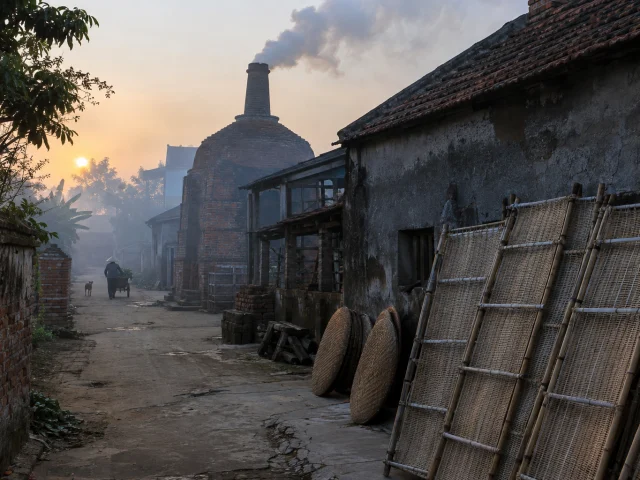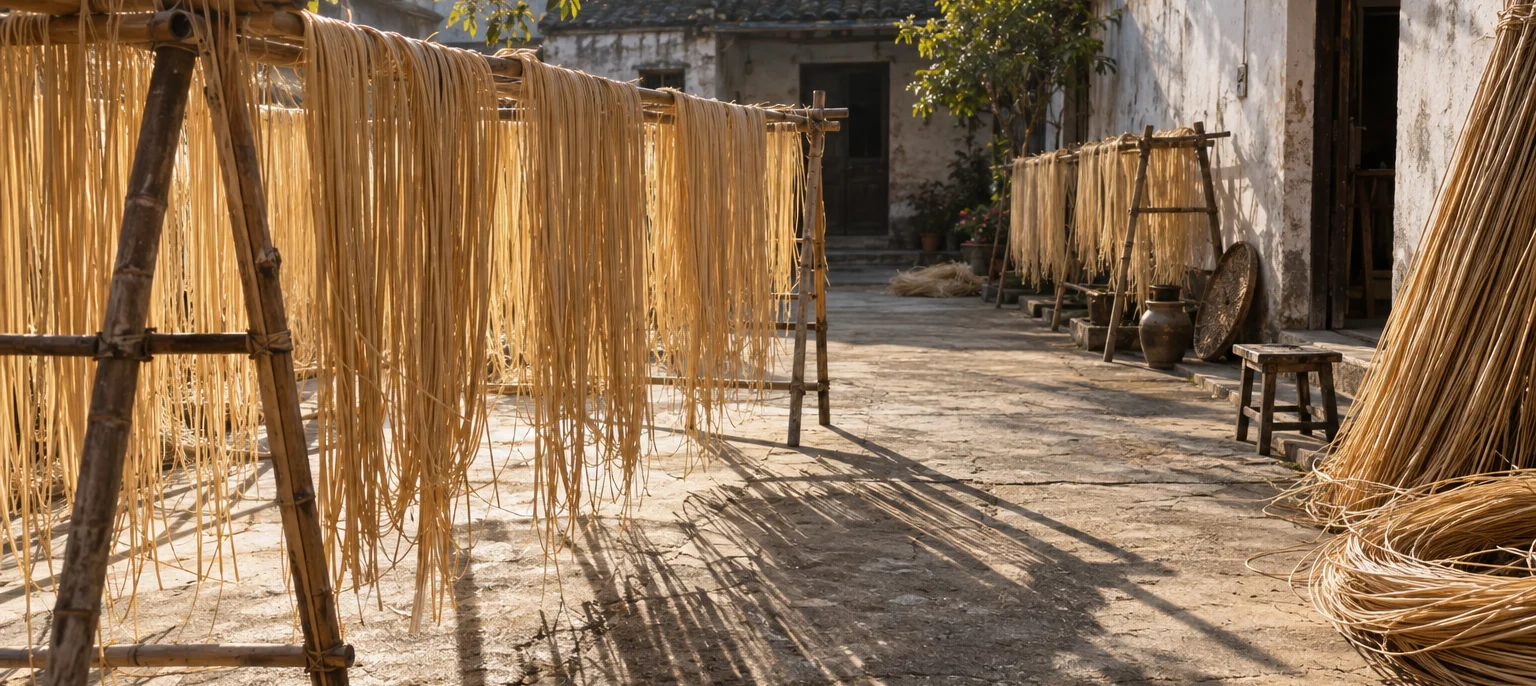
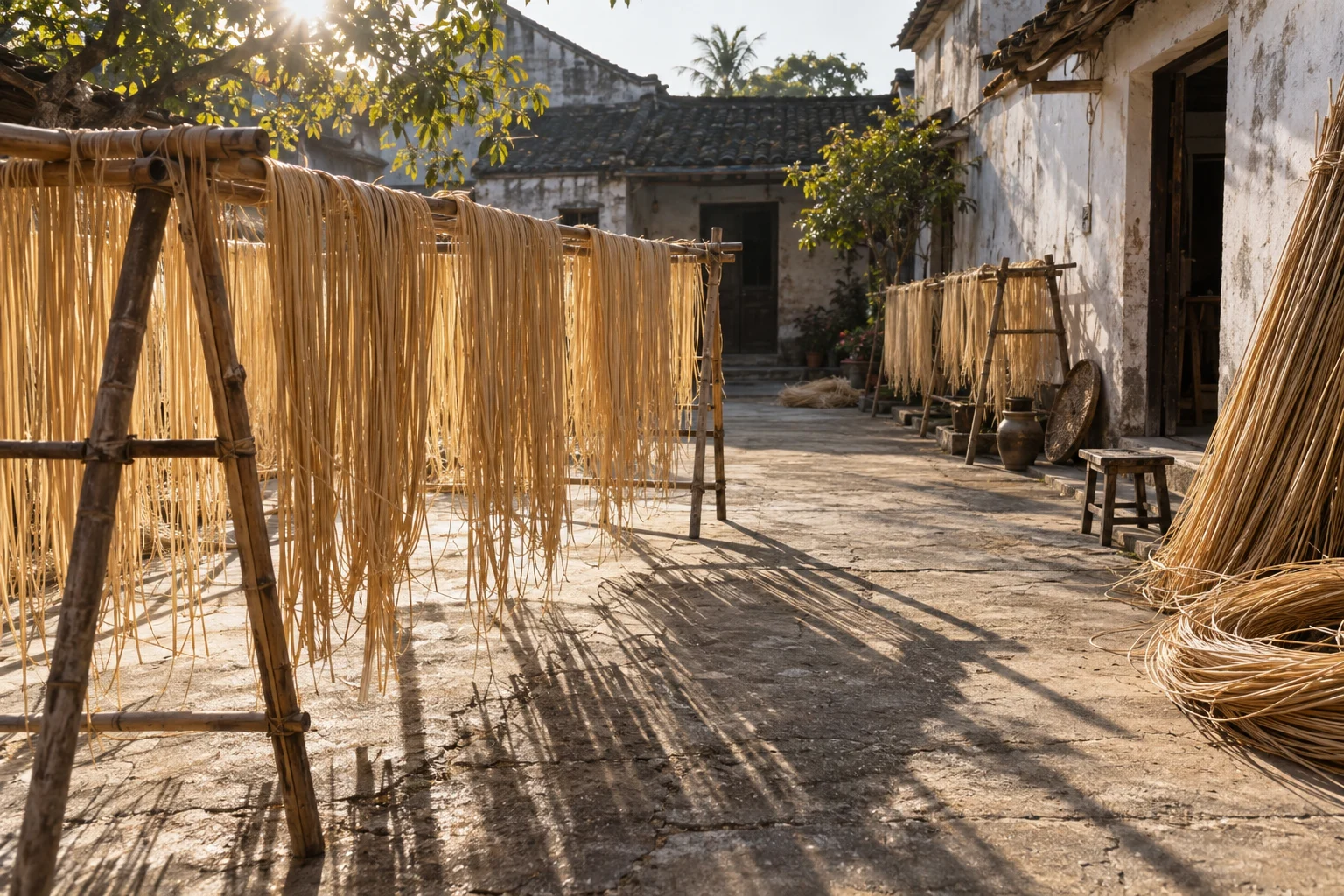
You can tell the season in Phú Vinh from the colour of the courtyards. In the dry months they are pale: split cane laid out on racks and mats, drying in the low sun until it bends without memory. In the rains they are empty, and the weaving moves indoors to the doorways, where the light is good until eleven.
Phú Vinh lies some thirty kilometres west of Hà Nội, in Chương Mỹ, where the delta begins to lift towards the hills. It has woven rattan and bamboo for around four hundred years, and it is one of those places where the craft is not a trade some families follow but the thing every household does. You hear it before you see it: the soft knock of a frame, the scrape of a knife along cane.
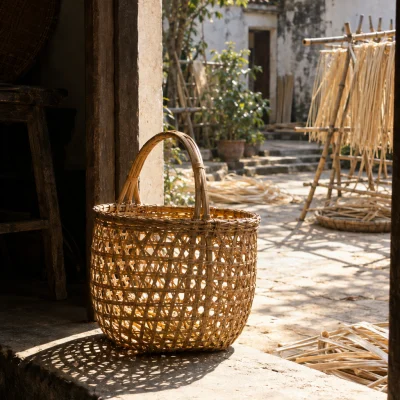
We came in November, when the racks were full. Nguyễn Thị Lan was in her doorway, as she has been for forty-seven years, with a market basket half made on her knee. Her grandmother sat in the same doorway. The open weave she was working — one over, two under, a spacing that lets the light through — was her grandmother’s, and the basket was for the market, where a Lan basket should go.
That basket is now the open-weave market basket we carry in an edition of ten: hand-split rattan on a bamboo handle, light enough to lift with a finger and strong enough to carry a week of vegetables. Every one has Lan’s small woven tag tied inside the rim.
I · Split, not cut
The difference between Phú Vinh’s fine work and the export cane you have seen a hundred times is decided with a knife. Rattan is split along its length, following the fibre, into strands a millimetre wide; a machine cuts across the fibre, and the cane is never as strong or as supple again. Lan splits her own. Her hands are smaller than the men’s, she says, so her strands are finer.
After splitting comes the sun. The strands are dried for days in the courtyard and left their natural honey colour. Much of the rattan sold abroad is bleached pale and sealed with varnish, which makes it uniform and also makes it brittle. Unbleached cane stays flexible, and it darkens slowly with handling and light, which is the point.
II · Counted, not seen
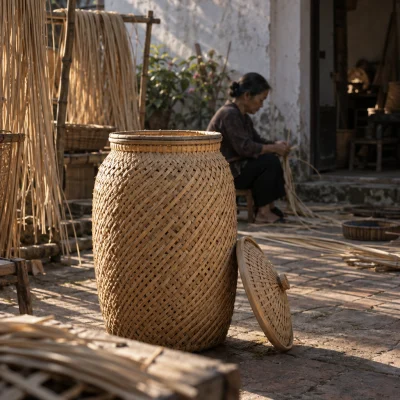
Across the lane, Trần Thị Mai was making a lid. Mai weaves the rain pattern — a diagonal that is counted, stitch by stitch, and cannot be corrected once a count is missed — and she makes the lid first because the lid decides everything. When it closes with a small sound, the vessel is right.
Her rain-pattern lidded vessel stands 34 cm tall on a bamboo rim and is made in an edition of six; each takes about five weeks. The diagonal has to meet itself where the weave closes at the back, and on the lid it must line up with the body when the lid is turned to its mark. A single miscount early on would show as a kink in the line, and the only remedy is to unpick it. Mai would rather start again.
Trần Thị Mai learned from her mother and from the village’s pattern books, and she is known in Phú Vinh for the tightest weave in the lanes. Nguyễn Thị Lan, fourth generation, is known for the opposite: a weave so open it seems to hold air.
III · Patterns with names
Every pattern in Phú Vinh has a name, a rhythm and a family known for it. Rain, fish-scale, mat, lotus. The mat weave is the plainest and the most useful, a tight over-and-under that makes a flat, even surface; Lan uses it for the set of three nesting trays on bamboo rims. The open hexagonal weave, worked over a bent frame, turns up in lanterns. The rain pattern is reserved for pieces that will be looked at closely.
The finest baskets of the village were once made to carry rice from the field, and the weave was close enough that a new basket would hold water for a minute. Nobody needs that now. The habit of closeness has stayed.
IV · How to tell good rattan
If you are choosing a woven piece, from us or anywhere, a few things are worth looking for.
- Even strands. Hand-split cane is consistent in width but not mechanically identical. Look for strands that are fine and supple, with no splintered or furred edges.
- Natural colour. Honey to pale gold, slightly varied. A chalky white usually means bleach; a high shine usually means varnish.
- A clean finish. The ends should be tucked and bound, not stapled or glued. Run a hand around the rim; it should be smooth.
- A lid that sits. On a lidded piece, the lid should drop into place without forcing and stay there.
Our page on rattan and bamboo weaving gathers every woven work we carry, with the patterns and makers named.
V · Living with it
Rattan asks for very little. Wipe it with a barely damp cloth and let it dry in the air. Keep it off wet floors and out of standing water. In a very dry climate or a heated room, a light mist of water once a season keeps the cane from becoming brittle. Over a few years it will darken from honey towards amber, and that is how you know it is being used. Full notes are on our shipping and care page.
VI · On the way out
The best time to see the village is November to April, when the cane is drying on the racks and the courtyards are pale with it. In the rains the lanes are quieter, and the work goes on behind the doorways.
The pattern of the roofs, we noticed on the way out, repeats in the baskets below them: the same diagonal, the same count. Nobody in Phú Vinh learned to weave. They grew up inside it.