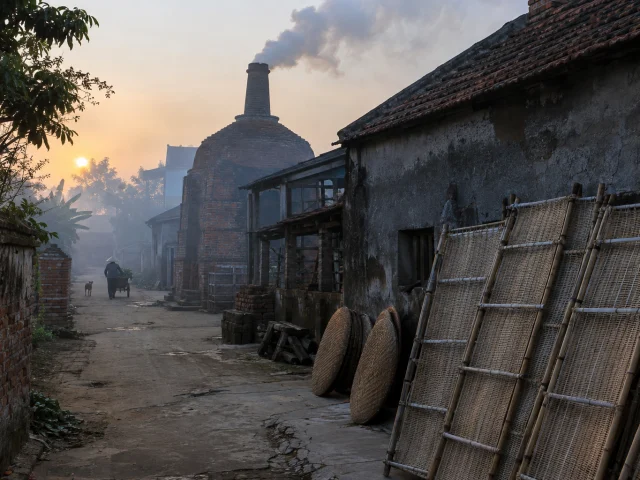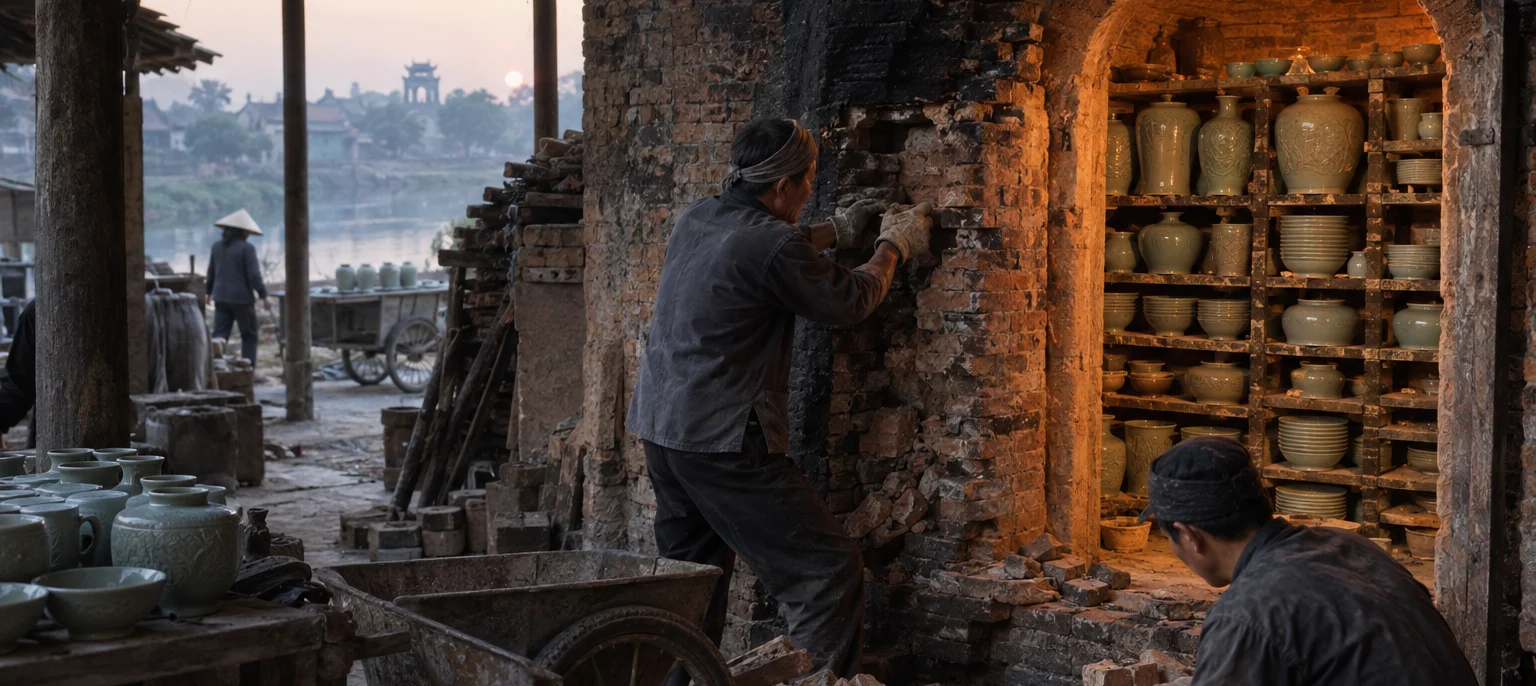
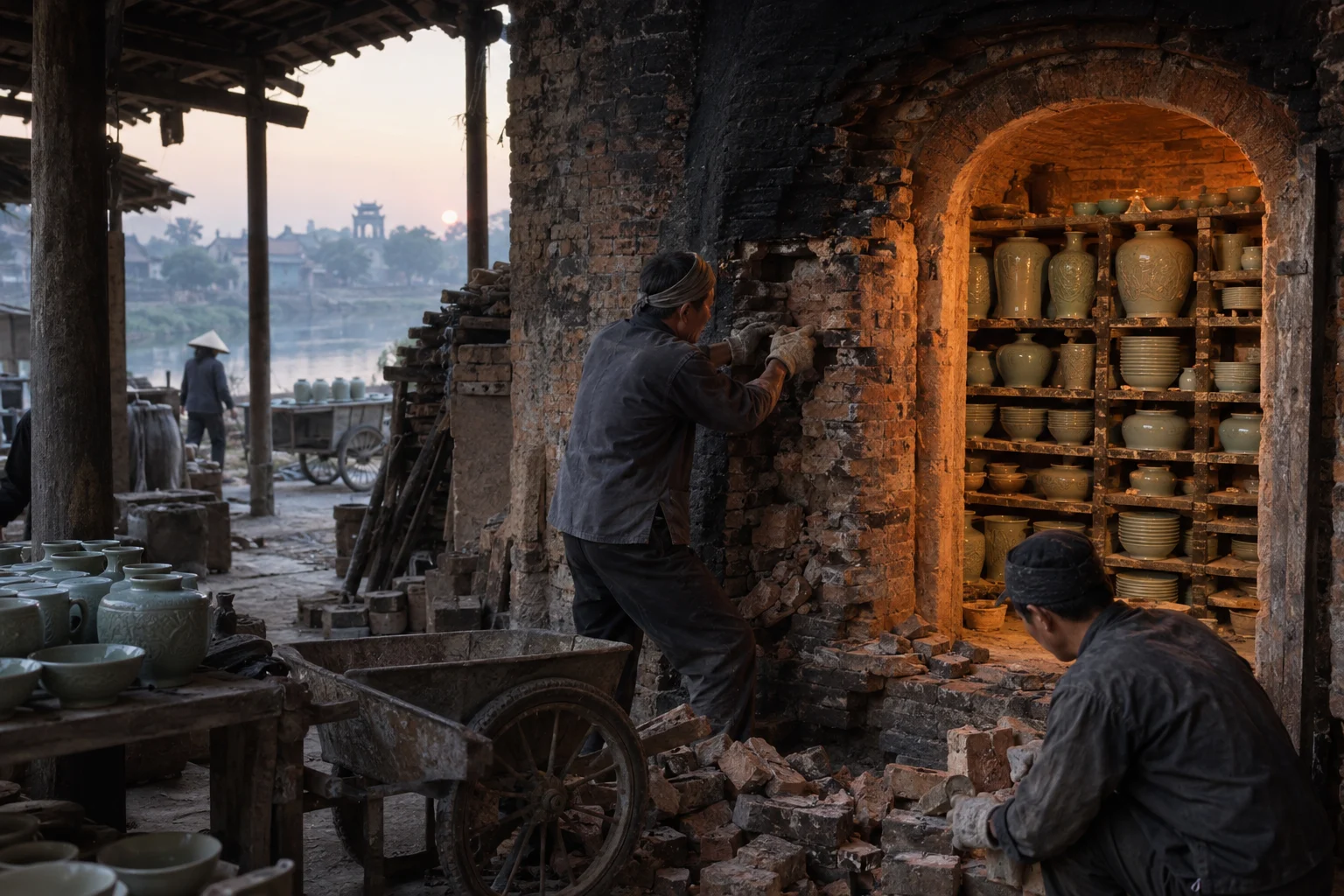
The kiln opens at dawn because the glaze was decided at dusk. That is how Phạm Văn Đức explains it, standing at the bricked-up door of the family kiln on the bank of the Red River with the light just coming, and it is as good a summary of Bát Tràng as any.
His celadon — men ngọc, jade glaze — is a recipe nobody has written down: the ash of a particular rice straw, clay from one bank, and a fire starved of oxygen for a day. Too much air and the green turns yellow. Too little and it goes grey. The decisions are made the evening before, when the kiln is sealed; the morning only reveals them.
Bát Tràng, the ceramics village on the Red River, has fired clay since the fourteenth century. It grew up on a bank of fine white clay fifteen kilometres downstream from the Old Quarter, and for most of its history every house was a kiln. The chimneys are fewer now. The glazes are still there, if you know whose door to knock on.
I · Six generations on one plot
The family has fired here since the nineteenth century. Đức’s father kept the glaze through the years when the village made bricks and nothing else, and taught it to Đức at the wheel in the 1980s, when the kilns came back. Most of Bát Tràng now fires for the trade — fast, bright, the same. Đức fires for himself, chooses from each load, and sells the rest to the village market.
That choosing is the part most visitors miss. A kiln load is not a production run. Pots near the door see a different fire from pots at the back; a bowl on a high shelf may come out a shade bluer than its neighbour. Đức walks the shelves in the first light and sets aside the pieces that are right. Those are the ones that come to us, and they are why our editions are small. His potter’s page lists everything currently chosen.
II · Clay, ash and fire
The clay is dug from the riverbank, washed and left in pits for months until it throws thin and fires pale. The glaze is made from that same clay and the ash of rice straw, ground and mixed by eye. There is a little iron in both, and the iron is what gives celadon its colour.
In an ordinary fire, with plenty of air, iron in a glaze turns amber or yellow-brown. Starve the fire of oxygen — reduction, potters call it — and the same iron turns green or blue-green. That is the whole secret of celadon, and also the difficulty. Reduction is not a setting on a dial. It is a day of feeding wood, closing dampers, reading the colour of the flame through a spyhole, and deciding, again and again, whether the kiln needs more air or less.
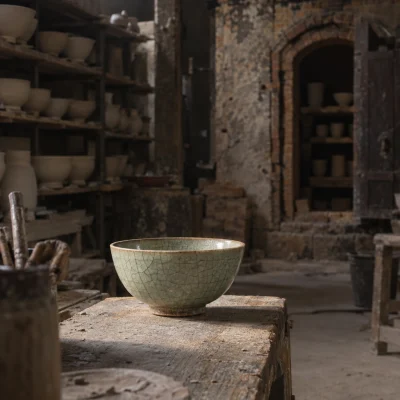
Đức’s celadon tea bowl with crackle glaze is thrown from white river clay, reduction-fired for a day, and measures 11 cm across. It is made in an edition of twenty, chosen from more. His seal is pressed into the foot of every bowl before the first firing.
III · The crackle
The thing collectors ask about is the crackle: the fine net of lines in the glaze that opens as the kiln cools. It is deliberate. Over years it takes on tea, and the bowl darkens along the lines until it is unmistakably yours. Đức considers that the beginning of the bowl’s life. “A bowl in a cupboard,” he said, handing us one still warm, “is only half fired.”
The crackle comes from the glaze and the body shrinking at slightly different rates as they cool. Đức controls it through the thickness of the glaze and the speed of the cooling. Thin glaze crackles finely; a thicker pool at the base of the bowl opens wider. You can sometimes hear it happening for days after a kiln is opened — a small, high tick as another line opens.
IV · From the same kiln
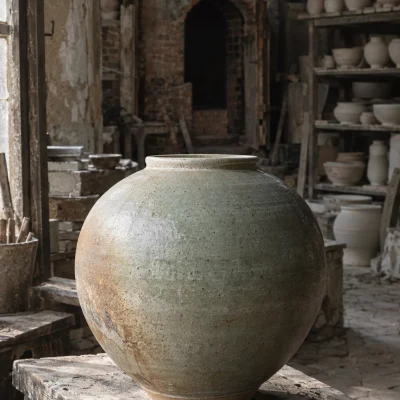
Celadon is not the only thing the family fires. The grey-green ash glaze, made from rice-straw ash and clay without the long reduction, gives a softer, more variable surface; no two loads come out alike. Đức uses it on larger forms, including the ash-glazed moon jar, thrown in two halves and joined at the middle, then wood-fired. The join is visible if you look for it, as it should be. For the table, the pair of celadon cups uses the same glaze as the tea bowl in a smaller, everyday shape.
V · How to tell good celadon
- Colour with depth. Good celadon is not a flat green. It deepens where the glaze pools, in the well of a bowl or above the foot, and lightens on the rim where it runs thin.
- An honest foot. Turn the bowl over. The unglazed foot shows the clay itself, and a maker’s seal pressed in before firing is a better guide than any sticker.
- Even crackle. A deliberate crackle is fine and consistent across the surface, not a few random fractures.
- Weight in the hand. Thrown well, the bowl should feel lighter than it looks, with walls that thin evenly towards the rim.
More of the village’s work, and the other kilns we have recorded, is gathered on our Vietnamese ceramics page.
VI · Using the bowl
Use it. Hand-wash, never the dishwasher. If the bowl is cold, warm it with a little hot water before you pour boiling water in; a sudden shock is the one thing that can crack a reduction-fired glaze. Then let the crackle take on tea. The lines will darken within a season of daily use, and within a year the bowl will look nothing like it did the morning it came out of the kiln. Our care notes for each craft travel with every piece.
We go back to Bát Tràng most months, and we try to arrive the evening before a kiln opening. Nobody sleeps much. At first light the bricks come out of the door one by one, the heat rolls out, and Đức reaches in for the first bowl and turns it in his hands before he says a word.