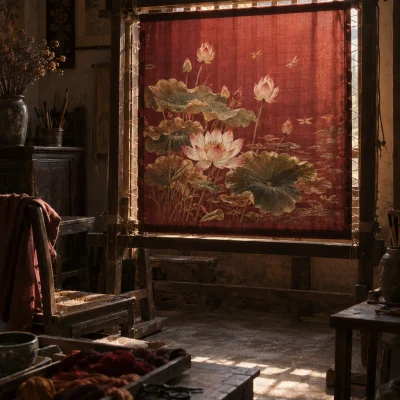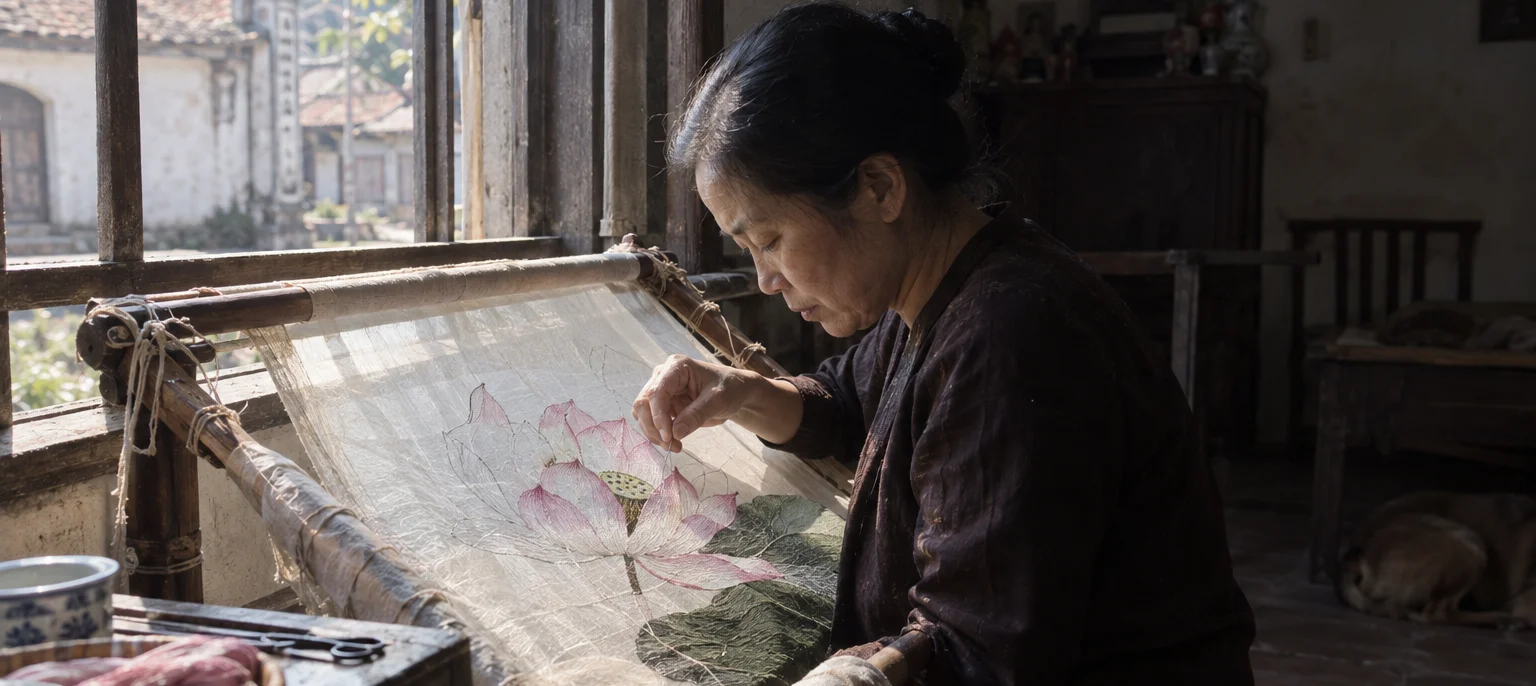
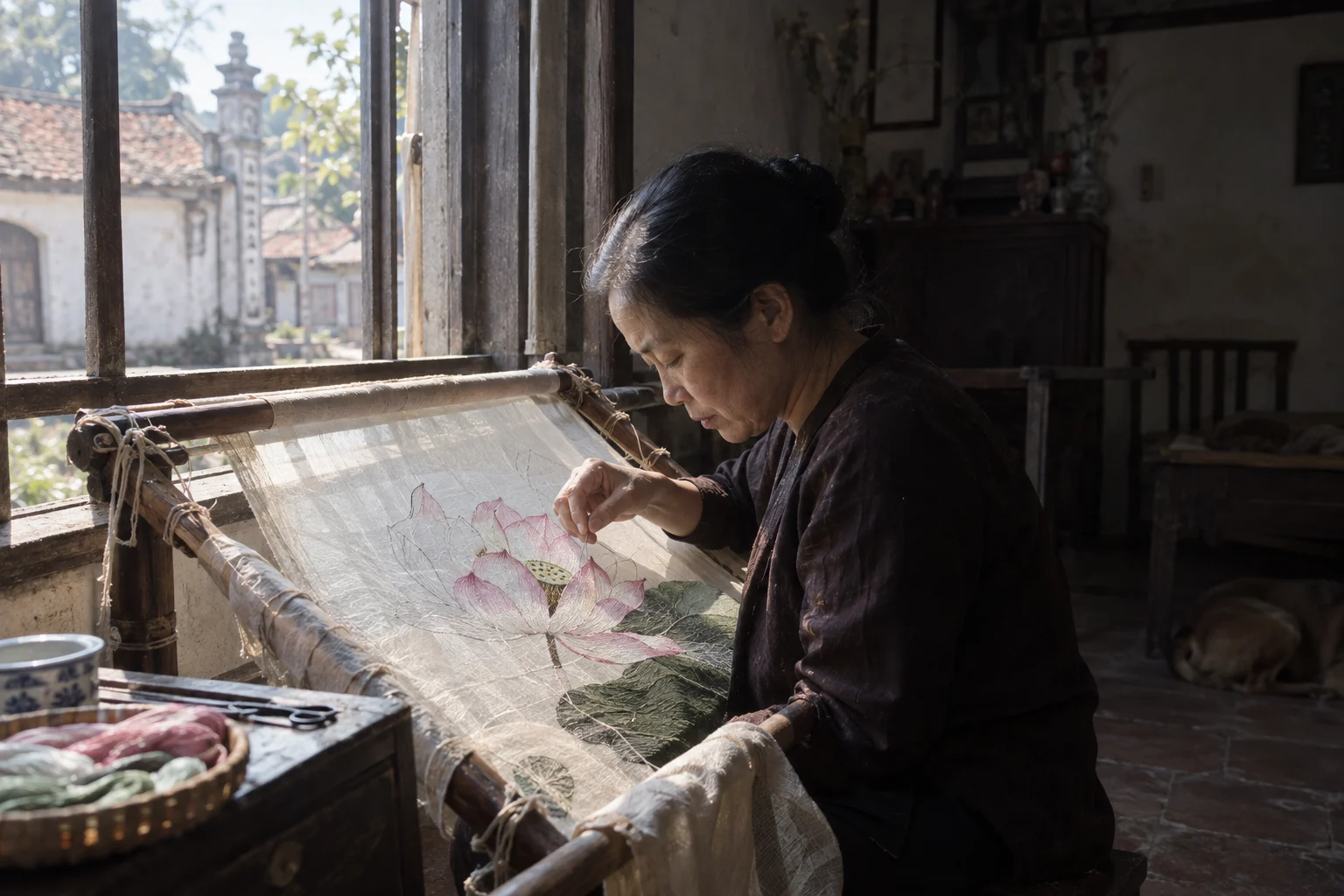
The frame stands in the window of a house a few lanes from the lacquer workshops of Hạ Thái, and from eight until ten each morning Lê Thị Hoa sits at it. After ten the light hardens, she says, and the needle starts to lie about the colour. So she stops.
Her lotus pond took a season of those mornings: the week of Tết to the first rains, four hours a day, on silk loomed by hand in Vạn Phúc. We visited four times. This is what we saw.
I · The village of the needle
Quất Động, the embroidery village of Thường Tín, lies some twenty-five kilometres south of Hà Nội and is often called the village that taught the north to embroider. The craft has been practised there for around four centuries. Frames stand in the windows of the lanes, and the best work is done early, one stitch at a time, while the day is still cool and grey.
Lê Thị Hoa is the fifth generation of her family at the frame. She learned from her grandmother, who embroidered altar cloths for the temples and communal houses of the district, and she has been stitching since 1990. Her signature is shading by stitch, with no dyed gradients at all.
II · The ground
Before there is a thread there is a cloth. The ground for the lotus pond is hand-loomed silk from Vạn Phúc, the silk-weaving village of Hà Đông, the next village along the road. It is woven on a wooden loom, slowly, and it takes the needle cleanly and holds its tension on the frame for months without slackening. It is stretched taut on the frame before the first stitch, and stays there until the last.
III · The thread
A single strand of silk is split into six before it is threaded. Hoa does this by feel, at the window, and the pieces are so fine they float. There are no dyed gradients in her work; the water and the petals are shaded by laying stitches of neighbouring colours side by side until the eye blends them.
Split thread is what gives the panel its light. A whole strand is twisted and catches light unevenly; a split strand lies flat, and a field of flat silk stitches all laid in the same direction reflects like water. Change the direction of the stitches across a petal and the same colour reads lighter or darker as you walk past. Hoa uses this the way a painter uses tone.
IV · The count
We tried to count. A petal the size of a thumbnail is around four hundred stitches. The pond has some sixty petals and a great deal of water. We stopped counting at a hundred thousand and took her word for the rest.
What the count does not show is the judging. Each morning begins with looking at the previous day’s work in the flat light, before a single stitch is added, because a shade that seemed right at nine can read too warm against the water the next day. A stitch that is wrong is taken out, not covered.
V · The last morning
On the eleventh of May she stitched her initials into the lower corner in a thread one shade off the ground, so you have to know to look, and left the panel on the frame a week more to settle. The first rains came that afternoon. From across the room it is a pond; from a hand’s width it is a decision made a hundred thousand times.
The finished work, Lotus pond, hand-embroidered silk, measures 62 × 46 cm unframed and is backed in linen. It is unique.
VI · How to tell hand embroidery
Machine embroidery has become very good, and from a photograph the two can be hard to separate. In the hand, they are not.
- Look at the shading. Hand shading by stitch blends colour gradually, with neighbouring shades overlapping irregularly. Machine work tends to step from one colour to the next in bands.
- Look at the surface. Split silk lies flat and soft, with a sheen that changes with the angle. Machine thread is usually whole, slightly raised and more uniform in its shine.
- Look at the edges. Hand stitches at the edge of a petal vary a little in length to follow the curve. Machine stitches are regular.
- Look for a signature. In Quất Động the maker’s initials are stitched into the work itself, not added on a label.
Hoa’s smaller pieces show the same method at a size that suits a narrower wall: the small embroidered kingfisher panel took six weeks of mornings. All our textile work is gathered under Vietnamese silk and embroidery.
VII · Seeing it for yourself
Quất Động is a few lanes from Hạ Thái, and the two villages pair naturally in a single day: embroidery in the morning, while the light is right for it, and lacquer after lunch. The best months are October to April. Arrive early. By ten the finest work has stopped for the day.
VIII · Framing and care
Silk embroidery has two enemies: light and damp. Frame it behind UV-filtering glass, with a small gap between the silk and the glass so the surface is not pressed. Hang it away from radiators and out of direct sun. Never let it get wet, and do not hang it in a bathroom or kitchen. Treated this way, the colours will hold for generations. We send every panel unframed, rolled and crated, with a framer’s note; the details are on our shipping and care page.
If you would like a panel to a particular size, Hoa takes a small number of embroidery commissions each year. They are worked the same way, two hours each morning, and finished when they are finished.