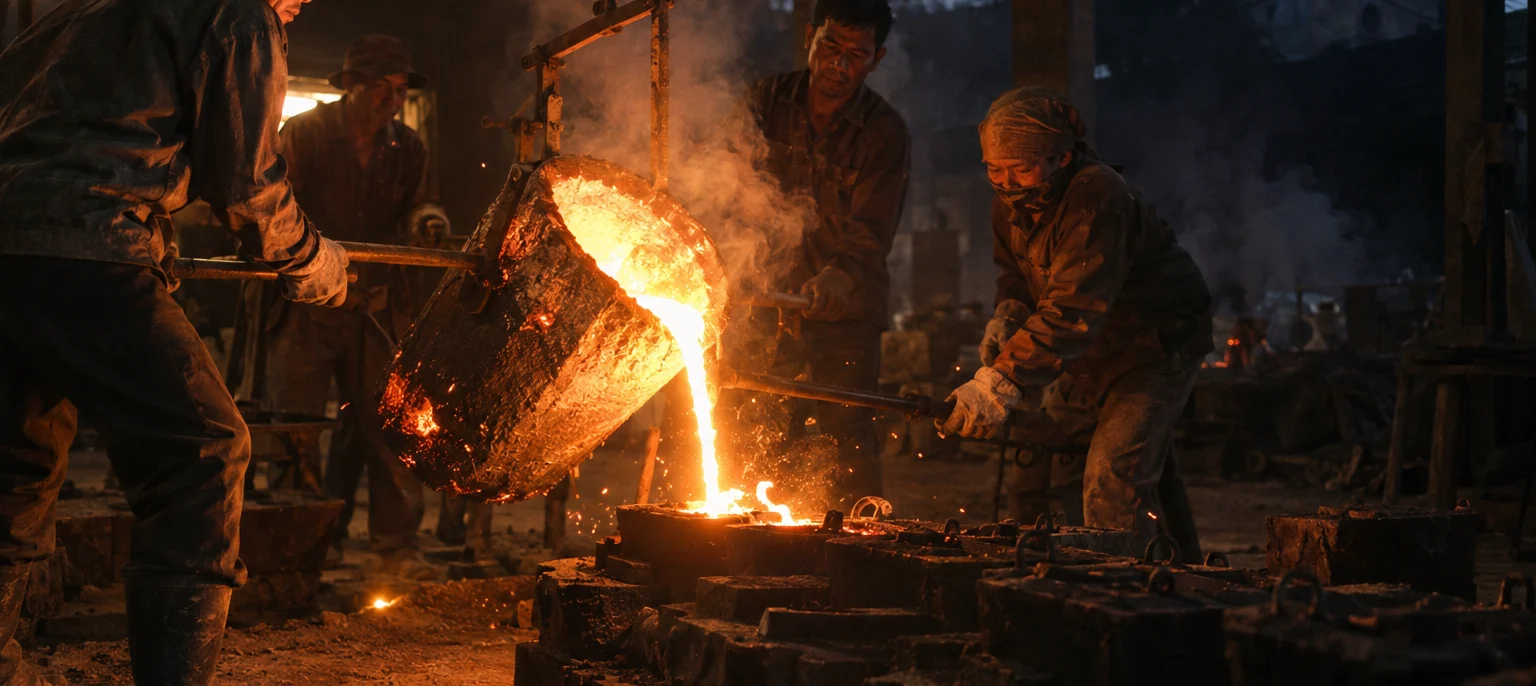
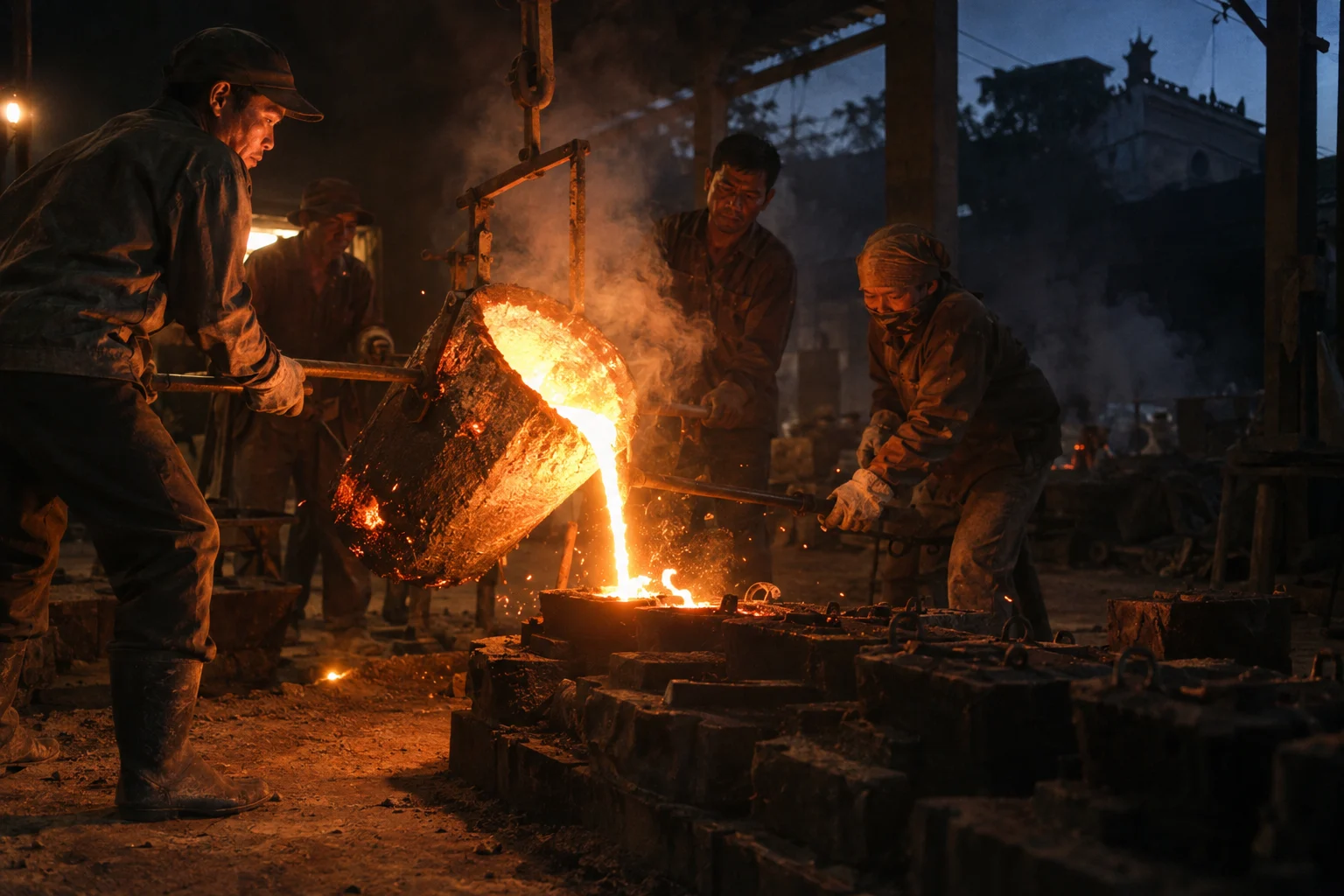
The foundry pours before the sun, when the air is cool enough for the metal to behave, and so we were in Đại Bái at four in the morning with Nguyễn Văn Sơn and a crucible the colour of the inside of a fire.
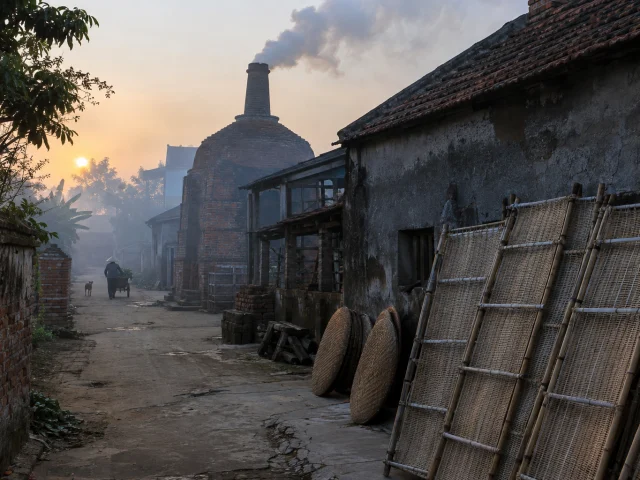
Đại Bái, the bronze-casting village of Bắc Ninh, lies some thirty-five kilometres east of Hà Nội, across the river. By day the lane rings with hammers and small chisels. Before dawn on a pouring day it is quiet except for the fire, and the families who are casting that morning stand in their yards in the dark, waiting for the metal to be ready.
I · The mould
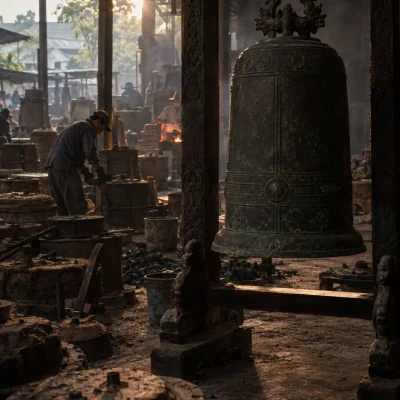
The mould had taken a month: sand and clay built by hand around the form and dried slowly in the yard. The pour took a minute. One continuous movement, no second chance, and then a long wait while the bronze cooled and the mould was broken to free it. Every bell in Đại Bái is cast once.
The sand is dug from the same field the family has always used, and the clay is mixed into it by hand until it holds a thumbprint. The mould is built in layers: a core for the inside of the vessel, an outer case for the outside, and a gap between them exactly the thickness the bronze will be. If the mould dries too fast it cracks; if it is poured damp, the steam spoils the casting. That is why the moulds made in the summer wait for the cooler months before they are filled.
II · The pour
Bronze is copper with a measure of tin, melted together in a crucible over a charcoal fire until it runs like water. Sơn judges the heat by colour. When it is ready, the crucible is lifted from the fire and tipped into the mouth of the mould in a single movement. A pause or a splash leaves a flaw that cannot be mended.
Then the waiting. A small piece cools in a few hours. A bell needs most of the day. Only when the mould can be touched is it broken open, and the casting comes out dark, rough and covered in burnt sand, looking nothing like the thing it will become.
III · A thousand years
The village has cast bronze since the eleventh century, by its own account; the temples of the north ordered their bells and censers here, the court its drums. The pattern Sơn chases into the cooled surface — the sun at the centre, the birds flying against the clock — is the one on the Đông Sơn drums, the delta’s oldest art.
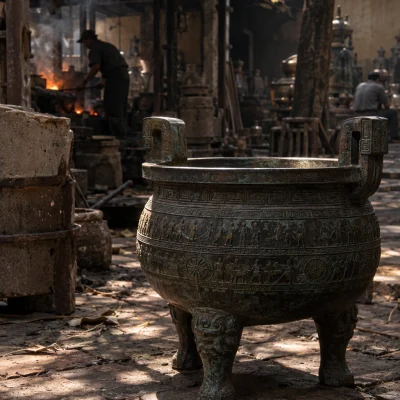
The Đông Sơn drums were cast in the Red River valley more than two thousand years ago, and their star-shaped sun and rings of flying birds are still the most recognisable image in Vietnamese metalwork. Nguyễn Văn Sơn, the seventh generation of his family at the same foundry, learned the pattern from his father, and from the drums themselves. His small cast bronze drum carries the sun and birds on its tympanum, chased by hand after casting.
IV · After the fire
What follows the pour is longer than everything before it: weeks of small chisels cutting the pattern into the surface, then the village’s own patina mixture, applied and left to deepen. Sơn asks that it be left alone afterwards. “The colour is still becoming,” he said, handing us a burner from last year that had gone the brown of a chestnut. We put it back on its tile.
The burner we carry now is his cast bronze incense burner, sand-cast in one pour, 18 cm across and made in an edition of eight. The larger work from this season is a cast bronze temple bell on a carved ironwood stand, unique, eighteen weeks from mould to patina. Its lip was tuned by hand after casting, a little metal filed away at a time and the bell struck again, until the note settled.
Sơn’s mark is the last thing to go on. It is chased into the base of every piece after the patina has set, so a piece is not signed until it is finished.
V · How to tell hand-cast bronze
- Chased, not cast-in. In Đại Bái the pattern is cut into the cooled metal with chisels. The lines are crisp, slightly varied in depth, and you can see where a stroke began and ended. A pattern cast into the mould is softer at the edges.
- A patina, not a lacquer. The colour should be in the surface of the metal, uneven and alive, not a coat of brown paint or clear varnish sitting on top.
- Weight. Solid bronze is heavy. The incense burner, at 18 cm across, weighs 2.6 kg.
- Small honesty. A sand casting carries traces of its mould: a faint texture inside, a mark where the metal entered. They are not flaws.
All our cast and chased work is gathered on our page about Vietnamese bronze.
VI · Living with bronze
Leave the patina alone. It is the work, not dirt on it, and metal polish will take off in a minute what took the village weeks. Dust with a soft brush. Keep an incense burner on a tile or stone, since the base gets warm. Strike a bell only with its wooden striker, never with metal. Over the years the colour will deepen and shift, as Sơn’s chestnut burner did; that is the bronze continuing to become what it will be. Full care notes travel with every piece, and they are also on our shipping and care page.
VII · Pouring days
The foundry pours most often from October to March, when the mornings are cool. If you are in northern Vietnam in those months, a pouring day is worth the early start: the dark yard, the fire, the minute of silence, and then the long, unhurried work of the rest of the season. We left at seven, as the sun came up over the yard and the hammering began.